*Update: Unfortunately I was forced to cancel my in-person-participation at the conference due to urgent private matters that reached me yesterday night. I will be giving the presentation remotely via Zoom. (As of 2024-09-18)*
In already two weeks we are going to meet in Frankfurt (Oder) for the next Tensions of Europe conference, discussing tons of history of technology and energy related research. I am really looking forward to it – both to the research announced in the great programme, and of course to see familiar faces again.
If you are also coming, please consider to visit my session and article presentation about hydro-nuclear entanglements in Soviet Ukraine. Please drop me a message if you want to meet and discuss collaboration – or if you just want to chat along! I am up for almost everything. In any case, I wish everyone a great time.
Here are the details:
20 September, Frankfurt (Oder) (Germany), 1.30 pm until 3 pm
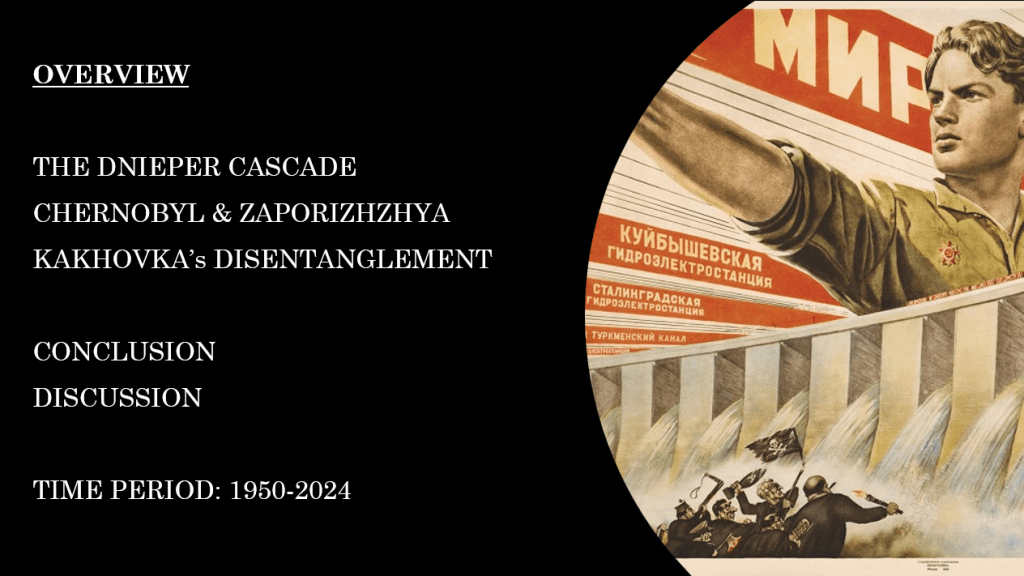
Individual Paper Presentation at the XI. Tensions of Europe Conference with the title: “Joining the Dnieper Cascade. An Envirotechnical Water-History of Chernobyl Nuclear Power Plant, 1950-1986.” Location: Gräfin-Dönhoff (GD Aula) Room GD 203, Panel “Environment”.
Abstract:
Chernobyl was built at the northern tip of the Dnieper Cascade – a vast industrialisation effort comprising six hydropower plants and their respective reservoirs. While the plant brought nuclear power to Ukraine, the construction of the station was based on experiences and knowledge gained during the construction of those six stations. As nuclear energy was embedded into a sociotechnical imaginary of progress, the success or failure of the plant was in the hands of non-nuclear workers, artisans, technicians, and operators. A shock of the old (Edgerton) was more often found at the site rather than the breaking innovation of nuclear power. The knowledge transfer from hydro to nuclear power was key at the construction site of the early 1970s. Concrete and water, mundane building technologies, mass mobilisation and the attributes of the planned economy characterised the construction site of this nuclear giant.
This presentation investigates how Chernobyl was built, but not in a conventional way. Instead, it will consider how the envirotechnical system of the Lower Dnieper basin was renegotiated by adding a nuclear facility to the Dnieper Cascade. Through the realisation of the Kiev Hydropower Plant and thus the creation of its vast reservoir, the envirotechnical system of Kiev Province changed profoundly. Through the addition of the nuclear power plant, it was further developed into yet something new, combining established hydropower expertise with futuristic nuclear experimentation on the domestic RBMK and All-Union nuclear know-how. This led to a technocratic reshaping of a unique envirotechnical system that enabled the industrialisation of agriculture in southern Ukraine’s steppe lands, industrial growth in major cities, and the creation of base load and steering capacities of the whole electricity grid. The recent destruction of the Kakhovka dam in June 2023 took this infrastructural development to headline media, underscoring the importance of understanding its implications.
This presentation will be updated with recent developments and analyses.
Discover more from Achim Klüppelberg
Subscribe to get the latest posts sent to your email.
 Achim Klüppelberg