It is Summer 2025 and I am working at my standing desk in a sunny southside apartment in southern Germany. It is one of the hottest days this year. There are many hottest days these days all around Europe. In fact, there are so many hottest days all over the place that many people start worrying about their own resilience to climate change, as well as that of their communities, families, and loved ones. The World Meteorological Organisation even states that every year between 2015 and 2024 had been the hottest year worldwide ever recorded.[i] What do we do if current heat trends continue to rise? What is our personal limit, the number of degrees and humidity that we can tolerate? What do we do if we cannot anymore? Climate change is real, and we are living in the midst of it.
Besides heat waves, there are also many unforeseen and sudden extreme weather events, such as massive rains, storms, landslides and floods. Hurricanes become more frequent and more violent in the Caribbean, as Hurricane Melissa has demonstrated in October 2025.[ii] The growing rhythms of plants are shifting. Many farmers need to water their crops earlier, only to find the harvest threatened by extensive bursts of rain later in summer. Some regions are experiencing crop failures, as insects find new habitats further north and domestic plants struggle to adapt to sinking groundwater levels and sunburn.
Worldwide climate researchers are fearing so-called “tipping points”. If these are reached, they would significantly exacerbate climate change and negative effects on us, animals, and plants. One of the most feared tipping point can be found in the Amazon rain forest in South America. Due to global warming, deforestation, droughts, (humanmade) fires, and human incapability to protect the forest, the world’s largest rain forest could first lose its role as a massive carbon storage (also called carbon sink), and secondly turn into a savannah. If this would happen, it could change “the global water cycle”, “damage[…] biodiversity, affect[…] agriculture, [and] caus[e] food shortages”.[iii]
A couple of years ago, the media and politicians told us that Germany’s and the EU’s cornerstone for climate change mitigation were the planting of trees, the protection of forests and the push for expanding the areas on which forests could expand into.[iv] Today a couple of years later, many forests look worse than before.[v] Unable to adapt to climatic changes, many trees fall ill and ultimately victim to bugs, such as the bark beetle. If one drives through the rural area of the Sauerland, in the industrialised Ruhr Area’s hinterland of Western Germany, you might be shocked at the expanse of forest destruction. The old practice of monocultures, in this case of planting spruces, is now causing widespread forest decline.
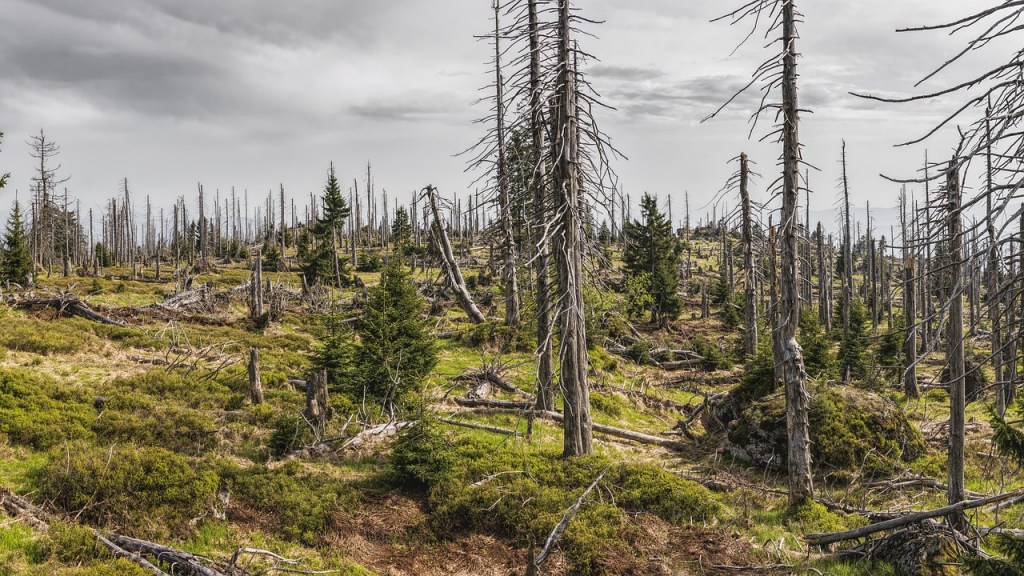
In the meantime, the open-pit coal mines in the Rhineland and Lusatia are expanding, forests are being destroyed for industrial purposes and high-speed roads.[vi] Additionally, the world community seems unable to even agree to basic rules regarding the production of new plastics, the recycling of existing ones, and the safeguarding of the environment from it – one of the contributing factors to climate change via its links to the oil industry.[vii] Disillusionment creeps into every nook of any reflected person’s conscience, if she tries to understand where we are heading, what could have been done to stop it, and the options we are left with.
No, despite the genuine and tremendous efforts of so many individuals, political groups, NGOs, churches and many other people to stop climate change during the last decade(s), to keep the 1.5 °C -cap of the Paris Climate Agreement, and to protect the foundations of a healthy life for all of us, the political landscape, especially the geopolitical, has not prioritised the protection of the environment.[viii] Quite the opposite: Profits, powerplay, expansionism, (neo-)imperialism, war, and capitalist greed are at the forefront wherever one tries to understand, why the world does too little, to avoid environmental and with that our own collapse.
It is a simple, although hurtful, truth that some people have more leverage on political decision-making than others. Liberal democracies may push for individual forms of freedom, but they are evidently unable to bridge the gap between the rich and the poor, between the powerful and the disenfranchised, between the influential and the voiceless. While we all have to always ask ourselves first, what we can do better and what we are complicit in destroying the foundations of our lives, the super-rich, the global companies, and the illicit networks of nepotism and theft are majorly to blame for the situation we are in. Despite the ruling individualist ideology that keeps telling us that our choices count – and of course they do, just not to the level of the more equal circles – it is the choices of CEOs, the Donald Trumps and Elon Musks, as well as the offspring of hereditary circles of wealth and power that are to blame for a large portion of the mess we are in.
Linked to this is also a tremendous backlash that we can witness in many cultural areas, and across the media landscape. Common places like the benefits of a plant-based diet, the equal role of women in the workplace, a rule-based society and international relations, as well as the bottom line of at least trying to be a kind person are under attack now. The headlines are being made by pompous, arrogant, and autocratic, if not outright dictatorial, men that simply gained power through wealth, a disillusionment of the electorate with democratic parties, and the old mixture of hate, fearmongering and proposing simple solutions on the backs of the so-called “others”.
Maybe we got into this situation, because for more and more people life is getting more difficult, while at the same time it seems less likely that traditional democratic parties offer solutions and pathways for a better future. Traditional party coalitions and policy decisions cannot gain the trust of the majority of the electorate anymore. At the same time, extreme right-wing parties as well as all-out Fascist leaders flood social and increasingly traditional media with their easy but hateful propaganda, further exacerbating the crisis of democratic parties and the political system as a whole.
For an activist, it hurts to perceive the right-wing backlash in so many fields of struggle, in which during the last years so much energy has been invested. The pandemic, the Russo-Ukrainian War, the wars in Sudan, the Middle East, Afghanistan and the migration crisis in Europe have all contributed to internal strife in European countries. It is a sign of the weakness of left-wing organisations, let alone parties, that workers and ordinary people see more and more their hopes fulfilled in the rise of extreme right-wing parties. These right-wing organisations are seemingly winning elections all across Europe. When they do, they always undermine democratic institutions and try to establish their own dictatorship, emboldened by neo-Fascist ideology.
It is interesting that from a Marxist perspective, fascism is the next evolutionary step of the neoliberal capitalist order of society. Since the discrepancies between promises and reality, between capitalist greed and the more and more felt planetary boundaries become oppressing, a significant score of people try to smooth over the divisions with autocratic rigidity and the channelling of anger on minority groups. While the Marxists were wrong during the Cold War, it seems now that their analysis proves right again: in order to protect the profits of the chosen few, society has to be autocratically ruled, co-influence by ordinary people abolished, and drastic changes to the group of people introduced that count as “we” or “inside”, in opposition to “them” and the “outside”. All the while, most people are economically struggling. Thus, many fall into the trap of right-wing propaganda. There are many reasons for this. Here, we want to look into energy, its provision and scarcity being one of them.
Most of our political life is determined by energy provision, consumption and safeguarding via an all-encompassing network of energy infrastructures. While getting to the bottom of a political problem, one often finds energy to be involved with it. If we understand energy in the furthest of meanings, we can imagine the main categories of heating, electricity generation, food, health and storage systems. We should look at our world through the eyes of energy experts, system builders, technocrats, and most importantly: ordinary people. Then we can account for what the situation is today in key areas, how we got there and what needs to change in order to mitigate the negative consequences of climate change, the collapse of biodiversity, and the foundations of our societies. Often one argues that humanity cannot change the course of its economic and societal path. I think we can, if we attempt to shift our focus on energy. While all of this is worthwhile the effort, in my eyes it would be unjustified, if we would not together start thinking about how we can actually change the status quo, overcome our differences, and create a just and prosperous world for all.
A better world is possible. Let’s start creating!
[i] World Meteorological Organization: State of the Global Climate 2024 (WMO-No. 1368), Geneva 2025, 3: “For global mean temperature, each of the past ten years, 2015–2024, were individually the ten warmest years on record.” [Deutsche Zahlen einfügen!]
[ii] McCluskey, Mitchell: Hurricane Melissa Leaves a Trail of Devastation after Tearing through the Caribbean, in: CNN World, 31 October 2025, https://edition.cnn.com/2025/10/29/americas/hurricane-melissa-damage-jamaica-cuba-latam-intl [2025-11-01].
[iii] N.N.: The JRC Explains: Could the Amazon Rainforest Become a Savannah?, in: The Joint Research Centre: EU Science Hub, 18 July 2025, https://joint-research-centre.ec.europa.eu/jrc-explains/could-amazon-rainforest-become-savannah_en [2025-11-01].
[iv] See European Commission: New EU Forest Strategy for 2030, https://environment.ec.europa.eu/strategy/forest-strategy_en [2025-08-23]; See World Economic Forum: This Dutch Scheme Is Using Free Trees to Tackle Climate Change, 6 December 2021, https://www.weforum.org/stories/2021/12/tree-climate-change-replanting-forest/ [2025-08-23]; NDR Panorama: PR-Mogelpackung: Bäume pflanzen fürs Klima, 11 November 2021, https://www.ndr.de/fernsehen/sendungen/panorama/archiv/2021/PR-Mogelpackung-Baeume-pflanzen-fuers-Klima,baeume292.html [2025-08-23].
[v] WDR: Viele Wälder im Sauerland und Siegerland zerstört, 07 May 2025, https://www1.wdr.de/nachrichten/westfalen-lippe/waelder-suedwestfalen-zerstoert-100.html [2025-08-23]. Also: N.N.: Weltweit mehr als 8,3 Millionen Hektar Wald zerstört, in: Tagesschau, 14 October 2025, https://www.tagesschau.de/wissen/wald-zerstoerung-zunahme-100.html [2025-10-29].
[vi] For Lützerath: Klüppelberg, Achim: Germany, January 2023: Digging Coal for Profits. Powerlessness and Empowerment in the Struggle for Lützerath, in: Occupy Climate Change, Atlas of the other worlds, Stockholm a. Barcelona September 2023: https://occupyclimatechange.net/lutzerath/ [2025-11-01]. For the protests surrounding the construction of the Autobahn 49 through the Dannenröder Forest: N.N.: Fünf Jahre “Danni bleibt” und die A49. Was vom Protest im Dannenröder Forst geblieben ist, in: Hessenschau, 01 October 2025, https://www.hessenschau.de/gesellschaft/danni-bleibt-und-die-a49-was-vom-protest-im-dannenroeder-forst-geblieben-ist-v2,dannenroeder-wald-108.html [2025-11-01].
[vii] McVeigh, Karen a. Bryce, Emma: Plastic Pollution Talks Fail as Negotiators in Geneva Reject Draft Treaties, in: The Guardian online, 15 August 2025, https://www.theguardian.com/environment/2025/aug/15/plastic-pollution-talks-geneva-treaty [2025-08-23].
[viii] Watts, Jonathan a. Xipai, Wajã: World Faces ‘devastating consequences’ after Missing 1.5 Degrees Climate Target, Says UN Head, in: The Irish Times, 28 October 2025, https://www.irishtimes.com/environment/climate-crisis/2025/10/28/change-course-now-humanity-has-missed-15-degrees-climate-target-says-un-head/ [2025-10-29].
Discover more from Achim Klüppelberg
Subscribe to get the latest posts sent to your email.
 Achim Klüppelberg