On 16 April the Subaltern Memories Conference will take place in Florence, Italy. By collaborating, the European Observatory on Memories (EUROM) (Barcelona) and the European University Institute (EUI) (Florence) are creating an exciting forum, a public space, in which the often invisible legacy of technological and natural disasters will be discussed. Whether we look at natural disasters in Italy or beyond, the Chernobyl catastrophe of 1986, or the environmental calamities of warfare presented on the basis of the Spanish Civial War and the current War between Russia and Ukraine, this conference aims at putting subaltern memories, experiences, harm, and problems into the focus. Typical stories and legacies built around overcoming and resilience will be challenged.
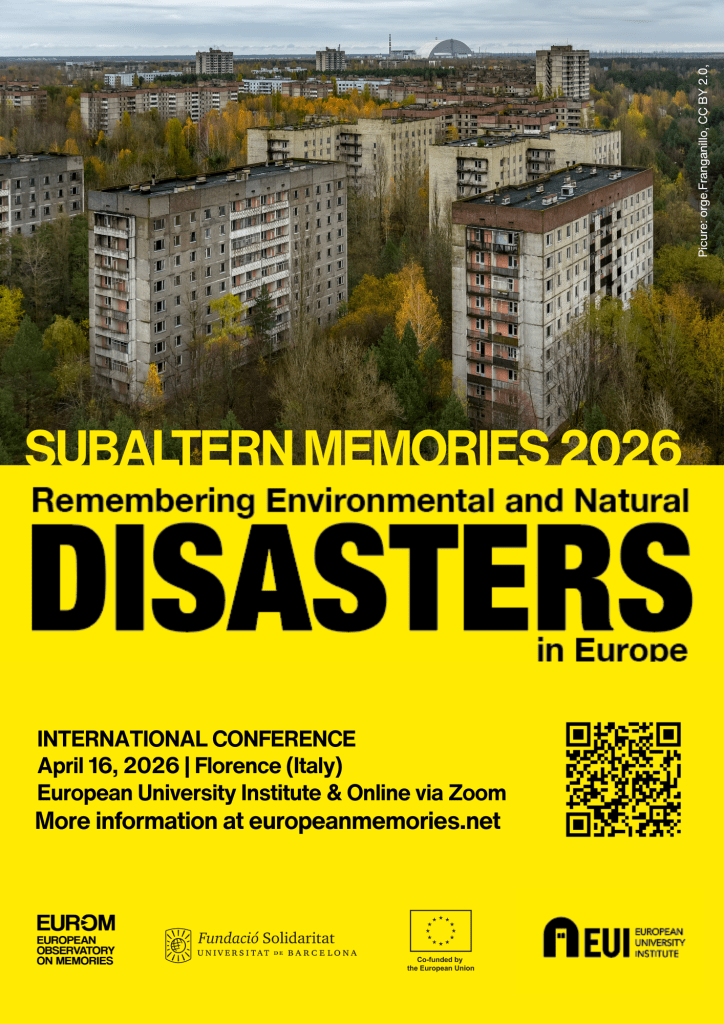
This conference is a hybrid-event. You can attend both in person and online via Zoom. The registration is for free. You can find the current programme here. It would be great to see you there!
Confirmed speakers are Corinna Unger, Santiago Gorostiza, Polina Baitsym, Chiara Calzana, and Monika Baar. I am very glad that I was invited to present a keynote during the afternoon. If you are curious, here is my abstract:
A Beacon of Hope, a Catastrophe, a Landscape Scar. Chernobyl’s (In-)visible Impact
Chernobyl Nuclear Power Plant in Northern Ukraine was not always a symbol of dystopia, nuclear technology gone awry, or of discarded livelihoods. When this nuclear giant was built, it embodied hope for a new generation of people, creating new (socialist) ways of life powered by futuristic and mighty technological appliances. Synergies between existing energy systems and this new and fascinating nuclear option were realised. Chernobyl started as a major infrastructural project, aimed at transforming a rural area, and propelling the whole region into Soviet modernity. Unfortunately, when the catastrophe of 1986 hit, this perception was profoundly and ever-lasting changed. Haphazard shortfalls in safety considerations, the blindly enforced mentality of plan-fulfilment, as well as the limitations of the Soviet economic system were open for everyone to see. Discussions were made, committees proceeded, and reports were written. The USSR tried to contain the negative consequences of the disaster, but they and the world community at large have failed in many regards. Families, villages, and cities suffered tremendously. Many problems still persist to this day, often unaccounted for by the authorities. The lobbying of the nuclear industry, the so-called Chernobyl Forum, and national interests of the different players soon pushed the attention away from individual suffering to institutional reasoning, blame gaming, and a perceived need to continue and forget. Today, Chernobyl Nuclear Power Plant still exists, and does not fail to produce problems. Encased in a second sarcophagus, which was breached by drone attacks, and located in a warzone, once again suffering is being made invisible. The danger is downplayed by the tenacity of quickly cascading horror news. If Chernobyl can become what Anna Storm called a “landscape scar”, healing has to take place. As of now, technocratic culture persists, while healing was postponed.
Discover more from Achim Klüppelberg
Subscribe to get the latest posts sent to your email.
 Achim Klüppelberg