The end of the year is approaching rapidly, and as usual the last pre-Christmas week is being used to tie up all those loose ends, that had been left untended during the last quarter of the year. Let me use this moment to wish you all a wonderful holiday season, with lots of cookies, regeneration, and new inspiration for the new year! Thank you for having been part of my journey during 2024, and I am looking forward sharing many more wonderful moments with you in the year to come.
If I look back at 2024, then I remember of course my PhD-defence at KTH Royal Institute of Technology in Stockholm, Sweden. On 22 March, my doctoral project culminated in this exciting public event, featuring so many respected scholars of the field. It was so special, I will keep it very dear to my heart for the years to come. Here I would like to once again thank my “former” supervisors Per Högselius, Kati Lindström and Anna Storm for their ongoing support, but also all the other colleagues and friends that made all of this possible. I hope you are doing well, wherever you are right now! While I am at it: Domingos Jaime Langa had defended his PhD two days ago: stort grattis, Domingos!
Apart from that, my 2024 had been characterised by me moving back to Germany and trying to set up shop in Darmstadt – so far with mixed success (privately super successful, careerwise not). As some of you know, I am searching for my next position, which turns out to be exciting in itself. My next position is supposed to have a greater positive impact on society, allowing me to use what I learned so far for the benefit of society, of plants, and of animals on this planet. Despite multiple job interviews so far, the proper match has not been made yet. So if you stumble across a suitable job offer, please share it with me. But – and I am super grateful for that – I was able to recover from the hardships of the last years and feel pretty good, ready to take on the next big task. That was not self-evident in March. Therefore, I am super curious what 2025 will have in store for me in this regard.
2025 will already have a move to another city in store for me. Apart from that the future is yet unwritten, or “the future is wide open“! 🙂 In any case I continue to work on my next publications, which will be two scientific articles based in nuclear energy history of Ukraine. I am also thinking about the theme for my next book and while I produce lots of ideas, I yet have to conceptualise everything into a concrete plan. I am also playing around with the thought of starting a podcast on political events, focussing on Eastern Europe. Maybe 2025 is the year when I should finally start this. Anyway, I will let you know.
So, once again, Merry Christmas! I am looking forward to a beautiful and productive 2025 with you!
PS: Here is some shameless self-advertisement. I hope you might endure this 🙂 – All my publications of 2024:
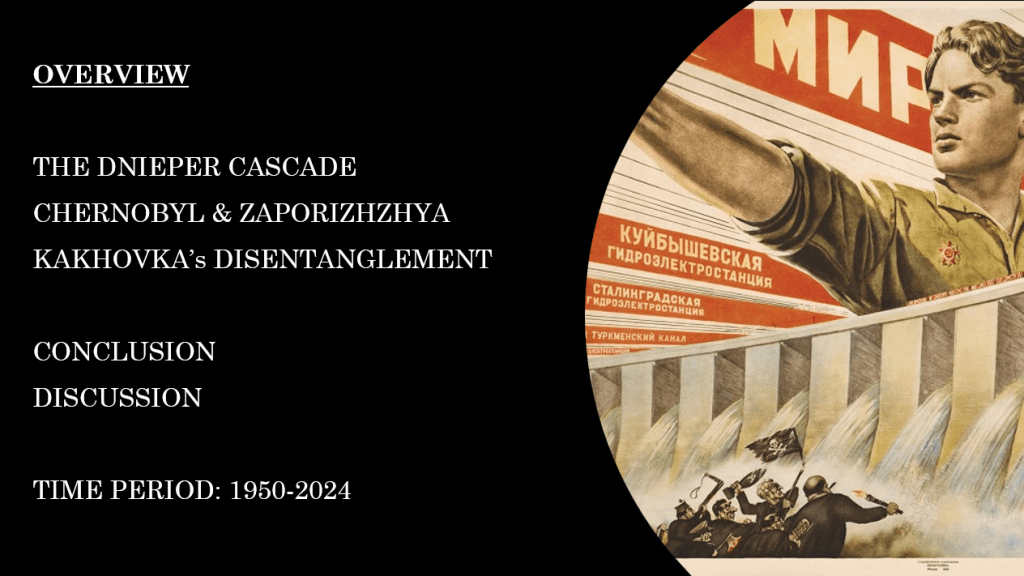
Klüppelberg, Achim:Joining the Dnieper Cascade. Hydro-Nuclear Entanglements along Ukraine’s Largest River, 1950-2024, Conference Presentation (online) at: 11th Tensions of Europe Conference, Frankfurt (Oder, Germany), 20 September 2024.
Högselius, Per/ Lehtonen, Markku/ Lindström, Kati/ Meyer, Jan-Henrik/ Klüppelberg, Achim/ Evens, Siegfried:The Future of Nuclear Energy in a Historical Perspective, Roundtable at the Teknik- och Vetenskapshistoriska Dagar, Stockholm 13 June 2024.
Klüppelberg, Achim:Joining the Dnieper Cascade. Hydro-Nuclear Entanglements Along Ukraine’s Largest River, 1950-2024, Presentation at Teknik- och Vetenskapshistoriska Dagar 2024, Stockholm 13 June 2024.
Klüppelberg, Achim:Der Energiekomplex Südukraine. Eine Kombination aus Landwirtschaft, Wasser- und Atomkraft, presentation at Technikgeschichte über Mittag (KIT Karlsruhe, TU Dresden and Gesellschaft für Technikgeschichte e.V.), 31 May 2024.
Klüppelberg, Achim: Hydro-Nuclear Entanglements in Soviet Ukraine, Presentation at the CHORUS Seminar Series, online on 18 April 2024.
Non-scientific
Klüppelberg, Achim:Warum stehen Atomkraftwerke meist am Wasser? Sowjetische Atomindustrie, in: Schwedische Kirche, Deutsche St. Gertruds Gemeinde:Gemeindeblatt, 3 (2024), 10-12.
Klüppelberg, Achim:Zum Geleit. Unsere Reise,in: Schwedische Kirche, Deutsche St. Gertruds Gemeinde:Gemeindeblatt, 3 (2024), 3-4.
This Thursday and Friday, 14-15 November, the GWTF, the Gesellschaft für Wissenschafts- und Technikforschung, is hosting her yearly meeting in my old hometown of Dortmund in the Ruhr Area in the western parts of Germany. The overarching topic will be about how we can conduct research in a changed environment. Here the precarity of many academic careers in our field will be discussed, as well as ways to recent political controversies which influenced the research community. Curious about their take on it, I will join this event and see who I will be able to connect to.
In the meantime, I am searching for my next position. While there were a few interesting talks with colleagues about a possible cooperation, nothing substantial came out of my search until now. So maybe I will be able to pick up some ideas at the GWTF, let’s see!
*Update: Unfortunately I was forced to cancel my in-person-participation at the conference due to urgent private matters that reached me yesterday night. I will be giving the presentation remotely via Zoom. (As of 2024-09-18)*
In already two weeks we are going to meet in Frankfurt (Oder) for the next Tensions of Europe conference, discussing tons of history of technology and energy related research. I am really looking forward to it – both to the research announced in the great programme, and of course to see familiar faces again.
If you are also coming, please consider to visit my session and article presentation about hydro-nuclear entanglements in Soviet Ukraine. Please drop me a message if you want to meet and discuss collaboration – or if you just want to chat along! I am up for almost everything. In any case, I wish everyone a great time.
Here are the details:
20 September, Frankfurt (Oder) (Germany), 1.30 pm until 3 pm
Individual Paper Presentation at the XI. Tensions of Europe Conference with the title: “Joining the Dnieper Cascade. An Envirotechnical Water-History of Chernobyl Nuclear Power Plant, 1950-1986.” Location: Gräfin-Dönhoff (GD Aula) Room GD 203, Panel “Environment”.
Abstract:
Chernobyl was built at the northern tip of the Dnieper Cascade – a vast industrialisation effort comprising six hydropower plants and their respective reservoirs. While the plant brought nuclear power to Ukraine, the construction of the station was based on experiences and knowledge gained during the construction of those six stations. As nuclear energy was embedded into a sociotechnical imaginary of progress, the success or failure of the plant was in the hands of non-nuclear workers, artisans, technicians, and operators. A shock of the old (Edgerton) was more often found at the site rather than the breaking innovation of nuclear power. The knowledge transfer from hydro to nuclear power was key at the construction site of the early 1970s. Concrete and water, mundane building technologies, mass mobilisation and the attributes of the planned economy characterised the construction site of this nuclear giant.
This presentation investigates how Chernobyl was built, but not in a conventional way. Instead, it will consider how the envirotechnical system of the Lower Dnieper basin was renegotiated by adding a nuclear facility to the Dnieper Cascade. Through the realisation of the Kiev Hydropower Plant and thus the creation of its vast reservoir, the envirotechnical system of Kiev Province changed profoundly. Through the addition of the nuclear power plant, it was further developed into yet something new, combining established hydropower expertise with futuristic nuclear experimentation on the domestic RBMK and All-Union nuclear know-how. This led to a technocratic reshaping of a unique envirotechnical system that enabled the industrialisation of agriculture in southern Ukraine’s steppe lands, industrial growth in major cities, and the creation of base load and steering capacities of the whole electricity grid. The recent destruction of the Kakhovka dam in June 2023 took this infrastructural development to headline media, underscoring the importance of understanding its implications.
This presentation will be updated with recent developments and analyses.
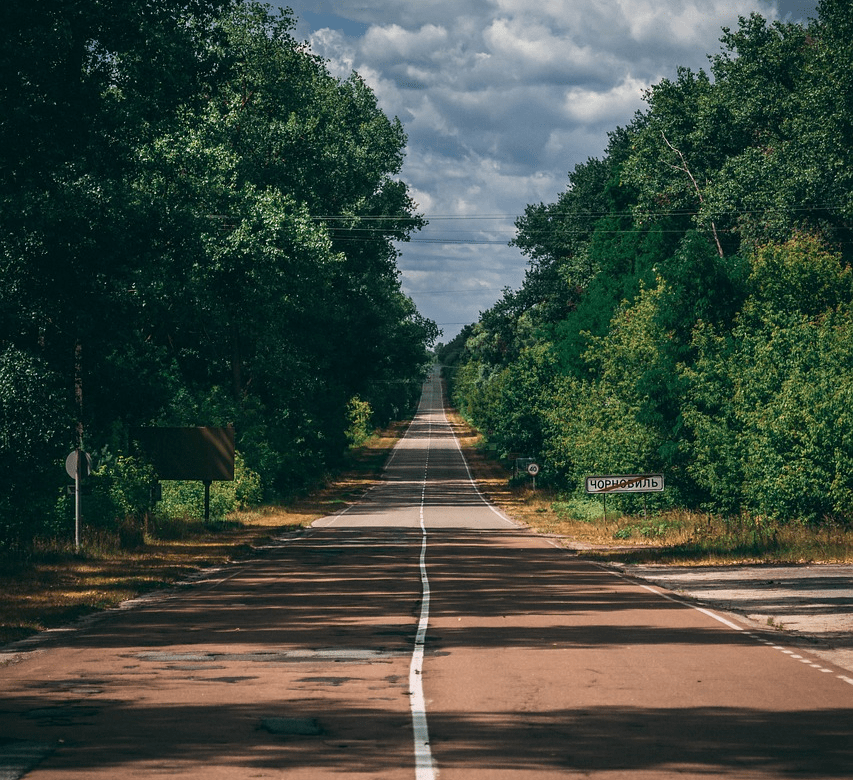
Today is the 38th anniversary of the Chernobyl catastrophe, which began on 26 April 1986 at 1.23 am. At the moment it is impossible to remember what happened at the downstream end of the Pripyat River without thinking about the horrible war taking place in Ukraine. What we witness right now has never happened before: a regular war fought on the territory of a highly nuclearised country, in which so-called civil nuclear power plants are used as objects of war. The recent drone attacks on Zaporizhzhya Nuclear Power Plant in mid-April 2024 are the latest and obvious examples of this. In this text I want to put Chernobyl back on our mental map while reflecting on what the ongoing catastrophe means in a context of all-out war.
By chriswanders (Pixabay)
For someone who follows my work it may come to no surprise that I have a sceptical attitude towards the work of the International Atomic Energy Agency (IAEA). This is the case because the IAEA continues to lobby for the promotion of nuclear energy amongst the international community, downplaying the risks associated with this technological system and endorsing high-risk construction projects, such as the floating Akademik Lomonossov as a nuclearising project for the fragile Arctic and the Rooppur Nuclear Power Plant in Bangladesh, prone to flooding. Despite this and regarding the hazardous situation in Ukraine right now, I have to concede that the IAEA is doing excellent work to bring the Russian and Ukrainian site together to safeguard Europe’s largest nuclear power plant called Zaporizhzhya and Ukraine’s remaining nuclear stations South Ukraine, Khmelnitsky, Rivne (Rovno), and Chernobyl.
Sure, Zaporizhzhya continues to be on the brink of a severe accident as a direct result from acts of war. But the IAEA continues their efforts despite the danger, pushing both sites to reason, trying to help to ensure that basic safety routines and operation practices can continue, even though the strain on personnel and physical structures is clear for all to witness. The IAEA’s general director Rafael Mariano Grossi repeatedly travelled with his team to Zaporizhzhya. I can only hope that these efforts prove to be fruitful, because I cannot hear any other influential voices of reason on neither the Russian nor Ukrainian side willing to engage with concrete results. The fate of the other nuclear power plants remains unclear and endangered. Given the current frontline, Zaporizhzhya is the most threatened plant, but the permanent shelling of – especially civilian – energy infrastructure by the Russian army, puts the others at risk as well.
In the meantime at Chernobyl, the power plant is recovering from the temporary occupation in the beginning of the war. Looting and warfare have led to a loss in monitoring and scientific equipment, as well as to an interruption in safety routines and operations. Being forced to spend 36.7% of its GDP for military expenditures due to the Russian aggression, the Ukrainian government is forced to neglect the efforts of maintenance and remediation at Chernobyl. While the horrible war continues, the released radioisotopes continue their decay and change their attributes, especially in regard to their mobility in both soil and water. This creates ever new challenges to containment efforts. Forest fires and the movement of troops led to small radioactive clouds that redistributed radioisotopes within the zone of exclusion. Perspectively, the whole Chernobyl site needs to be deconstructed and the scores of radwaste confined in a permanent storage, which up to date does not exist. The deconstruction of the old sarcophagus, which is currently confined under the new one, is delayed due to the Covid-19 pandemic and the war. It is clear that the war makes Chernobyl to some degree ungovernable which will result in even larger problems as time progresses.
It is of the utmost necessity that safety routines regarding Ukraine’s nuclear power plants are being restored as quickly as possible. Furthermore, nuclear power plants have to be exempt from warfare, as the possible consequences of accidents, or even intentional attacks, will be tremendous for Ukraine and for Russia, but also for the international community. In general, this war shows that safety concepts of civil nuclear power plants need to be reassessed. 38 years after the Chernobyl catastrophe begun, Ukraine’s first nuclear power plant continues to pose threats to the environment and human societies. It serves as an example of what can happen if one (!) reactor explodes. Ukraine potentially still has 15 active ones.
On Friday afternoon, 22 March 2024, I defended my PhD at KTH Royal Institute of Technology. In hindsight it was a marvellous day, with so many people thinking of me and participating in this event that marked the end of the journey I embarked on 15 October 2018. A huge “Thank you!” to all of you!
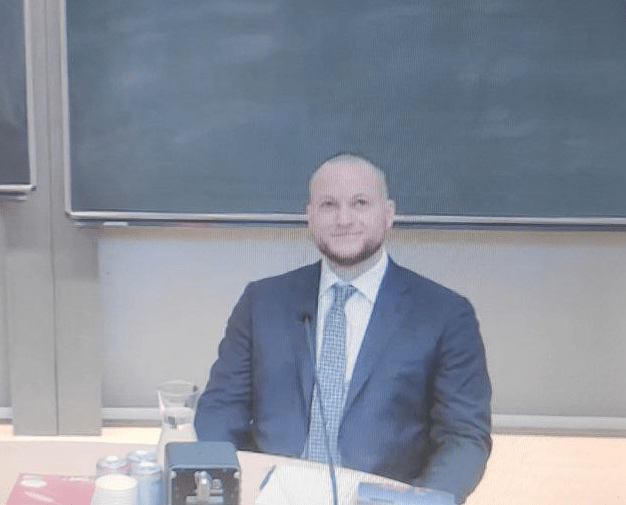
The defence had just begun: My opponent Melanie Arndt from Freiburg University presents my work, as is the tradition at our division. By Aliaksandr Piahanau on 22 March 2024, who himself acted as “ersättare” for the defence committee.
After the defence we headed to the division at Teknikringen 74D for a mingle, while we waited for the results of the discussion of the committee. I was very happy when Florence Fröhlig declared that I had passed. What a moment! Afterwards my supervisors gave me truly memorable speeches and the division sang a self-written song (tradition that is!) which was amazing.
22 March 2024, 2:01pm: We are just about to start. By Anina Vogt.
It still has not really registered that I have truly finished this project. Tomorrow will be my last day at KTH Royal Institute of Technology, to which I will fondly look back, with so many impressive memories. After Easter I will still work on tying up a few lose ends and then I will rest for half a year, which is desperately needed. From September onwards I will start working again, finding a new position and further developing my ideas and what I learned.
If I still have not responded to your kind email or message, I will certainly do so in the near future. Please bare with me, as everything was a bit overpowering. I sincerely appreciate every single one of them!
Five and a half years ago, on 15 October 2018, I joined KTH Royal Institute of Technology in Stockholm, Sweden, to embark on a journey of doctoral education. Working as a doctoral student in the Nuclearwaters-Project (ERC Consolidator Grant, PI Per Högselius), I focussed on the nuclear history of Eastern Europe, especially on the territory of the former Soviet Union and its successor states. Besides Per Högselius, Kati Lindström (KTH) and Anna Storm (Linköping University) helped me on this path as supervisors.
On 22 March 2024 this journey is now finally coming to an end: my defence will take place! If you want a physical copy, don’t hesitate to contact me (achim.klueppelberg[at]t-online.de).
This public event is hosted at KTH Royal Institute of Technology, Main Campus, F3-Lecture Hall, Lindstedtsvägen 26, on 22 March 2024 at 2 pm (we start sharp). We will be there from 1pm onwards, so feel free to drop in a few minutes before two o’clock. The defence might take roughly about three hours, depending on how it goes. Afterwards, we can come together at our Division of History of Science, Technology and Environment (KTH, Teknikringen 74 D) for a joint mingle. You can also join digitally: https://kth-se.zoom.us/j/63881830014
Abstract
After the development of nuclear weapons, civil applications were seen as a way through which protagonists of Soviet modernity could embrace a new future, which Josephson called atomic-powered communism. Where hydro-powered communism had reached its boundaries, nuclear energy was to take over. Crucial parts of the Soviet nuclear industry were based on the use of water. The mantle of progressiveness, innovation, and status previously embodied by the hydropower industry was taken up by emerging nuclear technocrats. While scholars have readily engaged nuclear power as a topic, they have neglected its hydraulic roots and hydro-nuclear entanglements, especially for cooling and other technological purposes. An important but yet overlooked influence came from the creation of Soviet hydraulic-hydropower technological systems.
This doctoral thesis fills a twofold gap in the existing literature. First, water is placed at the centre of an analysis of the Soviet nuclear programme. Pipes, valves, tanks, pumps, pressure mechanics and gravity approaches all use much older inventions and engineering mindsets, which are generally not considered in the existing historiography concerning nuclear energy. Aquatic systems, riverbeds, industrial improvements, watersheds, and fluid pathways of potential contamination have not sufficiently been linked to the rapid development of the nuclear industry, even though toxic radioisotopes were spread across the globe.
Second, it analyses how technocratic culture influenced nuclear decision-making processes. Therefore, discourses of siting Soviet nuclear power plants in the period between 1954 and 1991 are analysed under a water and technocratic culture perspective to tap more accurately into the links between the nuclear industry, hydraulic engineering, economic imperatives, power and hierarchy, as well as state-communist ideology. The dominant culture present at the construction site of a nuclear power plant determines the circumstances, within which regimes of nuclear safety are defined and operated. If we want to understand the underlying reasons for why nuclear safety was mismanaged in the USSR, we need to investigate the details and everyday decision-making process made by people on the ground, also in order to see which mistakes should not be repeated in the future. Therefore, this work proposes an original technocratic culture analysis to explain these issues within a Soviet context, based on three subcategories designated as political, nuclear inner circle, and safety culture.
Consequently, insights from these investigations shall serve to broaden our understanding of the phenomenon of the Soviet nuclear industry’s fast development, by answering the main research question of how technocratic culture influenced hydraulic engineering practices in the Soviet nuclear industry and how this affected safety. The two foci, water and technocratic culture, are interlinked and thus investigated together. By highlighting hydro-nuclear entanglements at crucial nuclear installations throughout the USSR, this thesis contributes to a more sophisticated understanding of the environmental consequences such a technological system entails, stressing the necessity for nuclear safety under the long shadow of the state-communist legacy that continues to influence how we live in Europe today.
Sammanfattning (på svenksa)
Med historiska rötter i det sovjetiska atombombsprojektet sågs civila tillämpningar av atomtekniken som ett sätt för förespråkare av sovjetisk modernitet att omfamna en ny framtid, vilket Josephson har kallat “atomdriven kommunism”. Detta innebar att där den vattendrivna kommunismen hade nått sin kapacitet skulle kärnkraften ta över. En betydande del av den sovjetiska kärnkraftindustrin kom att baseras på användningen av vatten. Det nexus av progressivitet, innovation och status som tidigare hade förespråkats av vattenkraftindustrin, antogs även av kärnkraftteknokrater. Medan tidigare forskning har intresserat sig för kärnkraftshistoria i stort, har de hydrauliska och hydro-nukleära aspekterna, särskilt för kylning och andra tekniska ändamål, förbisetts. Skapandet av sovjetiska vatten- och vattenkraftsystem är väsentliga för en heltäckande förståelse av kärnkraftindustrin.
Denna doktorsavhandling fyller en dubbel lucka i den befintliga litteraturen. För det första sätts vatten i centrum för en analys av det sovjetiska kärnkraftsprogrammet. Rör, ventiler, tankar, pumpar, tryckmekanik och gravitationsmetoder använder mycket äldre uppfinningar och tekniskt tänkande, som i allmänhet inte tas i beaktande i den befintliga historieskrivningen om kärnenergi. Vattensystem, flodbäddar, industriella förbättringar, vattendelare och vattnet som en väg till potentiell kontaminering har inte i tillräcklig utsträckning kopplats till den snabba utvecklingen av kärnkraftindustrin, även om giftiga radioisotoper kom att spridas över hela världen.
För det andra analyserar avhandlingen hur den teknokratiska kulturen påverkade beslutsprocesser inom kärnkraftindustrin. Diskurser rörande placeringen av sovjetiska kärnkraftverk under perioden mellan 1954 och 1991 analyseras med fokus på vatten samt den teknokratiska kulturen för att beskriva kopplingarna mellan kärnkraftindustrin, vattentekniken, de ekonomiska imperativen, hierarkier, och den statskommunistiska ideologin. En utgångspunkt i avhandlingen är att den dominerande kulturen som finns på byggarbetsplatsen för ett kärnkraftverk bestämmer under vilka omständigheter kärnsäkerhetsregimer kan definieras och verka i. För att förstå de bakomliggande orsakerna till varför misskötsel av kärnsäkerhet förekom i Sovjetunionen, behöver detaljerna undersökas. Här görs det med fokus på vardagens beslutsprocess – det som görs av människor på plats, vilket också kan ge insikter i vilka misstag som inte bör6upprepas i framtiden. Detta arbete föreslår en teknokratisk kulturanalys, baserad på tre underkategorier: (1) den politiska, (2) den inre cirkeln av kärnteknik samt (3) säkerhetskulturen, för att besvara dessa frågor i ett sovjetiskt sammanhang.
Insikter i denna avhandling bidrar till en bred förståelse av den sovjetiska kärnkraftindustrins snabba utveckling, genom att besvarandet av den huvudsakliga forskningsfrågan om hur teknokratisk kultur påverkade vattentekniska metoder och praxis i den sovjetiska kärnkraftindustrin och hur detta i sin tur påverkade säkerheten. De två fokusområdena, vatten och teknokratisk kultur, är sammanlänkade och undersöks därmed tillsammans. Genom att lyfta fram hydro-nukleära sammanflätningar vid viktiga kärntekniska anläggningar i Sovjetunionen, bidrar denna avhandling till en bättre förståelse av de miljömässiga konsekvenserna av ett sådant tekniskt system, och betonar nödvändigheten av kärnsäkerhet under den långa skuggan av det statskommunistiska arvet som fortsätter att påverka hur vi lever i Europa idag.
Zusammenfassung (Deutsch)
Nach der Entwicklung der Atomwaffen wurden zivile Anwendungen der Kernkraft als legitime Wege gesehen, mit denen die Protagonisten einer sowjetischen Moderne in eine neue Zukunft starten konnten. Diese Zukunft nannte der Historiker Paul Josephson einen durch Atomkraft angetriebenen Kommunismus. Als die Expansionsmöglichkeiten der Wasserkraftindustrie ausgereizt worden waren, sollte die Kernkraft übernehmen. Der Nimbus der Fortschrittlichkeit und der Innovation, der vorher durch die Wasserkraftindustrie verkörpert worden war, wurde nunmehr von den aufsteigenden Technokraten der Atomindustrie übernommen. Obwohl viel zur Kernkraft geforscht worden ist und entscheidende Teile der sowjetischen Atomindustrie auf die Nutzung von Wasser angewiesen waren, blieben die hydrotechnischen Wurzeln und Verflechtungen größtenteils unbeachtet. Ein wichtiger aber bislang vernachlässigter Einfluss kam durch die vorherige Erschaffung des technologischen Systems der Wasserkraftwerke, Kanalbauten und anderer hydrotechnischer Anlagen. Die sowjetische Atomindustrie wurde auf der Grundlage dieser Errungenschaften aufgebaut.
Diese Doktorarbeit hilft zwei Lücken in der bisherigen Literatur zu schließen. Erstens wird bei der folgenden Analyse des sowjetischen Atomprogramms das Element Wasser ins Zentrum gerückt. Rohre, Ventile, Tanks, Pumpen, Hydraulik und Schwerkraftansätze gingen alle auf viel ältere Erfindungen und Baudenkweisen zurück. Wassersysteme, Flussbette, industrielle Ameliorationen, Wassereinzugsgebiete und fließende Verbreitungswege von möglicherweise kontaminiertem Wasser wurden nicht hinreichend berücksichtigt und mit der schnellen Entwicklung der Atomindustrie angepasst. Eine Gefahr bildeten dabei giftige Radioisotope, die mittlerweile über Atomkraftwerke in die Umwelt abgegeben und über den ganzen Globus verteilt worden waren.
Zweitens wird in dieser Arbeit analysiert, wie eine technokratische Kultur den Entscheidungsfindungsprozess in der Atomindustrie beeinflusst hat. Deshalb werden hier unter anderem Diskurse beleuchtet, in denen Entscheidungen zur Standortwahl von Atomkraftwerken getroffen worden sind. Hierbei wird sich auf den Zeitraum zwischen 1954 und 1991 konzentriert. Außerdem wird dies in einer Perspektive getan, die sich auf die Aspekte Wasser und technokratische Kultur fokussiert, um sich den Verbindungen zwischen der Atom- und Wasserkraftindustrie, ökonomischen Imperativen, Macht, Hierarchie und8staatskommunistischer Ideologie anzunähern. Die dominierende Arbeitskultur, welche beim Bau eines Kernkraftwerks vor Ort vorherrschend ist, bestimmt jene Umstände, in denen Sicherheitsregime definiert und umgesetzt werden. Wenn wir die tiefgreifenden Gründe verstehen wollen, weshalb es zu einem Fehlmanagement im Bereich der Atomsicherheit in der UdSSR gekommen ist, müssen wir die Details und den alltäglichen Entscheidungsfindungsprozess derjenigen untersuchen, die vor Ort konkret gearbeitet haben. Dann können wir auch sehen, welche Fehler dabei in Zukunft nicht wiederholt werden sollten. Deshalb schlägt diese Arbeit eine technokratische Kulturanalyse vor, die auf den drei Unterkategorien der politischen, der Atominsider- und der Sicherheitskultur basiert, um diese Sachverhalte im sowjetischen Kontext zu erklären.
Folglich tragen die Ergebnisse dieser Untersuchung dazu bei, unser Verständnis des Phänomens der schnellen Entwicklung der sowjetischen Atomindustrie zu verbessern. Dazu wird die Hauptforschungsfrage beantwortet, inwiefern technokratische Kultur Wasserbaupraktiken in der sowjetischen Atomindustrie beeinflusst und wie sich dies auf die Sicherheit ausgewirkt hat. Indem hydronukleare Verflechtungen an wichtigen Atomanlagen in der UdSSR herausgestellt werden, trägt diese Dissertation zu einem besseren Verständnis derjenigen Umweltfolgen bei, die solch ein technologisches System hervorruft. Hierbei wird betont, wie wichtig nukleare Sicherheit unter dem langen Schatten des Erbes des real-existierenden Sozialismus ist.
Today many brave people are demonstrating in Germany against the fascist AfD (Alternative for Germany). It would be great if the party could be forbidden on the basis of extreme rightwing propaganda, which denounces the right to live for everyone.
Greetings especially go out to the protesters in Dortmund, Gießen and Göttingen. I hope the demonstrations are going to turn out massive and powerful. AfD needs to be stopped!
But of course, demonstrations are just one way to articulate legitimate progress. It is also important to not tolerate fascist tendencies among your fellow neighbours, family and friends. If we are not vigilant, AfD might get the chance to influence the future government of Germany, just as they have already demonstrated in Thüringen and Saxonia.
2023 was a turbulent year for me. I am grateful for many great experiences that helped me to grow as a novice scholar and as a person. In the following I would like to reflect in a few paragraphs on this past year. But before I start: Merry Christmas and happy end-of-the-year holidays to everyone! I hope you will have a marvellous New Year’s Eve and that you will find the strength to follow up on your new year’s resolutions.
My 2023 started unconventional as I stayed for six weeks in the 180.000-people-town of Darmstadt in Western Germany (close to the Frankfurt with the airport). As visiting scholar at the Division for History of Science led by Martina Heßler, I was able to discuss our work in a new environment and to pick up on some new theory perfectly fitting for my dissertation. I also found new (and old) friends there, which was great. This stay certainly also helped to keep the connection between our division at KTH and Darmstadt alive.
On 20 March 2023 it was time for my final seminar (80%) of my doctoral education. Eglė Rindzevičiūtė from Kingston University in London travelled from the United Kingdom to Stockholm to discuss the development of my dissertation. This seminar was a key event in my education at KTH and it helped me to improve my text tremendously. Following this seminar I regrouped and then created a plan for finishing the dissertation. A plan that later had to be revised.
In 2023 I presented my research in Darmstadt (Germany), Tübingen (Germany), Bern (Switzerland), and at different venues in Stockholm. As always, presenting helps to sharpen the arguments and the feedback from the audience supports the writing process. Personally, I enjoy public speaking and while these events were stressful, they were also all very rewarding.
From spring until the end of 2023 I also acted as PhD-representative at our Department of History and Philosophy at KTH. This was a new experience for me on a doctoral level of student administration; a responsibility I at first did not want to take over but eventually fit in reasonably well.
As 2023 was coming to a close, the writing and finalisation process of my dissertation took over all my work. Slowly I finished all my teaching responsibilities and focussed on improving the kappa and the individual articles. In the end, the writing took longer than we previously planned. Nevertheless, the defence is now scheduled for 22 March 2024. After some brief holidays, I will start again working on the dissertation on 2 January in the new year.
“Thank you” to everyone who impacted my work so positively during the past twelve months! Let’s hope 2024 will be even better, with lots of Nuclearwaters-publications coming up.
Resulting from an exciting PhD-course on Public Humanities at Uppsala University, headed by Maria Ågren and Sven Widmalm, recently an edited volume on public history was published. When I came to the office a couple of weeks ago, I found a handful of freshly printed copies, which made me very happy!
In “Public History in Action. Past and Present Practices of Making History Public”, we have explored several ways and techniques of how to engage the general public with academic historiography. Some examples are the creation of historic boardgames, Reddit threads, acting as an expert witness in land-disputes, worker’s history written by labourers themselves, and innovative ways of rethinking museal exhibitions. But the book contains many more.
I am grateful that I was able to contribute a chapter about an exciting event, Johan Gärdebo, Siegfried Evens, and I organised back in June 2019. At KTH’s former nuclear reactor hall (“R1”), we viewed together the last episode of HBO’s miniseries “Chernobyl”. It was a fascinating session that resulted in inspiring disccusions afterwards.
If academic history is supposed to be relevant to our societies, academics need to regularly interact with the broader public. This book provides several ideas on how this can be done.
Klüppelberg, Achim: Using Historical Media to Start a Public Debate on Nuclear Energy. Watching HBO’s “Chernobyl” 25 Metres Underground, in: Cornu, Armel/ Smedberg, Carl-Filip/ Vorminder, Sarah (eds.): Public History in Action. Past and Present Practices of Making History Public (Opuscula Historica Upsaliensia 61), Uppsala (Opuscula Historica Upsaliensia) 2023, 93-111.
Siegfried Evens, Achim Klüppelberg, and Johan Gärdebo at the event in R1 in 2019. Picture by “Ny Teknik”.










 Achim Klüppelberg