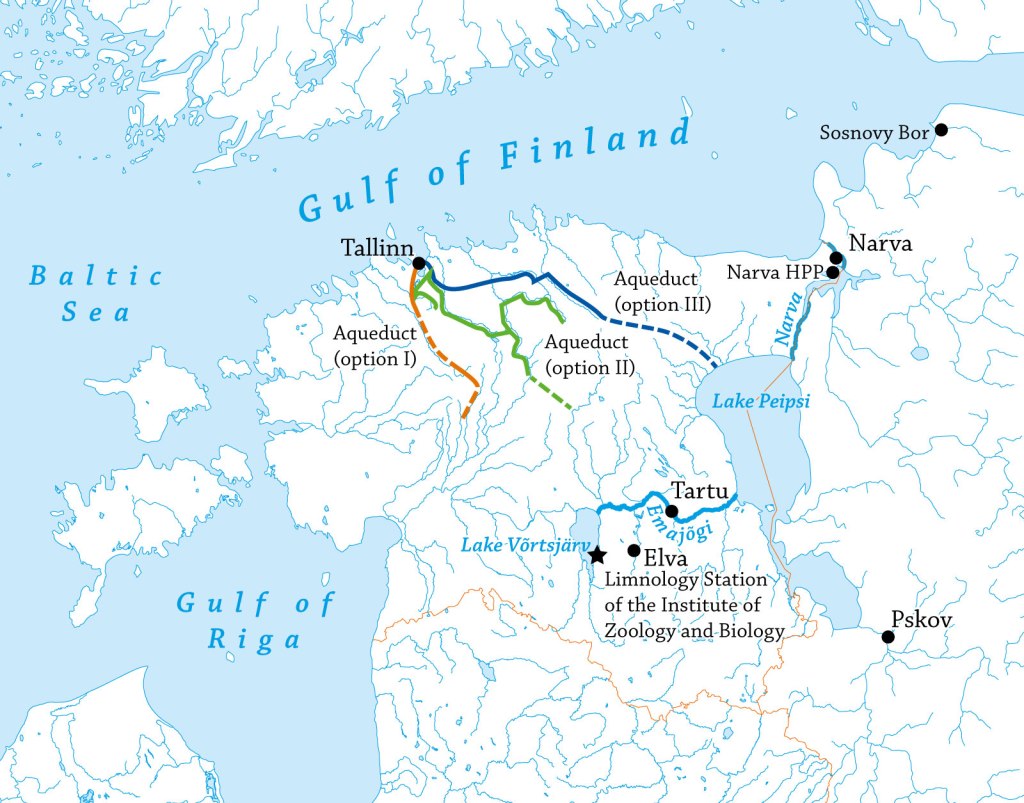
Recently, Kati Lindström‘s and my article about a Soviet-Estonian nuclear power plant never actually built at Lake Võrtsjärv has been published in the journal “Environment and History“. Honestly, this is awesome! Kati and me worked so hard on this article since 2019, when I first came across an ominous nuclear power plant dot in a map of Charles Dodd’s book “Industrial Decision-Making and High-Risk Technology”. I was struck, because this dot was located in Estonia. But up to my knowledge, there was never a large-scale nuclear power plant realised in this Baltic country. So in our Stockholm office I went up to Kati and asked her about it. Intrigued, she tapped into her Estonian network and it turned out that there was actually much more to it than we initially thought… and off we went to Estonia to hunt the ghost of this nuclear power station. In the end, this ominous dot could have simply been a mistake on that map. Nevertheless, it led us to an adventurous path of research, in which we discovered an exciting history of relatively concrete plans to build said nuclear station. Ultimately, this story was more about fish and the actual waterbody that was supposed to feed four RBMK-1000s (Chernobyl-type reactors), than nuclear technology or uranium.
In any case, a huge shoutout to Kati Lindström, with whom it was an absolute pleasure to discover Estonian nuclear history. I also want to mention all of our awesome interviewees, who shared their stories with us and who gave us a plethora of oral sources in a situation characterised by the total abscence of any accessible written documents regarding this case. Sadly, some of these people are no longer with us and cannot read what we produced based on their testimonies. Additionally, I also want to thank all archivists that helped us in Estonia, Lithuania, Russia, and Ukraine to find this one golden file. Sometimes, good articles need six years until publication!
So, if you are interested in this open-access publication, you can find it here! Enjoy!
Abstract
One of the most mysterious stories in Estonian energy history revolves around the planning of a nuclear power plant (NPP) at Lake Võrtsjärv between 1967–1972. Despite the absence of planning documents in the energy archives and the impracticality of an NPP given Estonia’s abundant oil-shale energy production, the story, though sounding fishy, is well established in media and oral sources.
In a regime where open confrontation with the central government was risky, alternative resources in the envirotechnical system of the NPP, such as water, fish and land, were mobilised to protect the lake. By utilising envirotechnical systems as a method to locate alternative sources, we have traced the negotiations within the central planning processes of inland fisheries and water resources. As ecosystemic nature protection strengthened, scientists managed to defer the NPP and reorganise the entire fisheries industry at Lake Võrtsjärv, recovering the populations of valuable fish.
Citation
Lindström, Kati, and Klüppelberg, Achim. “A Fishy Tale of the Nuclear Power Plant Never Built in Estonia: An Envirotechnical History of Energy, Fish, Land and Water Resources Planning at Lake Võrtsjärv.” Environment and History, 04 August 2025.
Discover more from Achim Klüppelberg
Subscribe to get the latest posts sent to your email.

