On 25 September, I was invited for this year’s GWMT annual meeting to Dresden, Germany. Within the halls of the German Hygiene Museum in Saxonia’s capitals I received the NTM Article Prize for Young Authors. My article “Creating Chernobyl. Technocratic Culture and Everyday Life in Nuclear Ukraine, 1970-1982” convinced the board. Naturally, I am very grateful and happy for this award.

Furthermore, I was honoured by the outstandingly kind laudation, held by Prof. Dr. Christopher Neumaier. Many thanks go to the organising committee and everyone who contributed to thie marvellous evening. Of course, I am also very grateful for my former working environment at KTH Royal Institute of Technology, where I was educated and enabled to conduct that sort of research, which was now rewarded. After all that struggle introducing the new analytical concept of Technocratic Culture to energy historiography, it felt amazing to find recognition along the peers of the GWMT.
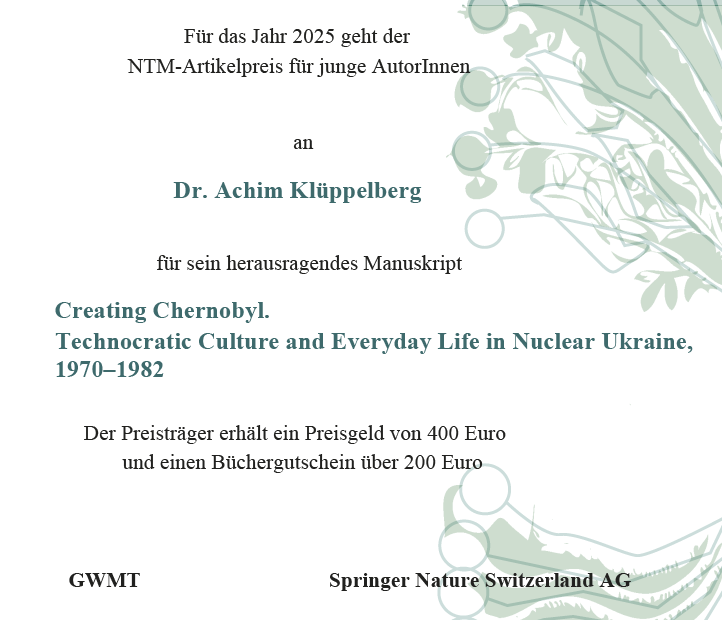
Here is the article, which found such splendid reception:
Abstract:
Starting in 1970, this article studies how Chernobyl Nuclear Power Plant was built. It follows the station’s operational history until 1982. During that year, reactor block one suffered a torn reactor channel, four years prior to the well-known catastrophe of 1986. It uncovers the genesis of these accidents by analyzing everyday history at the construction site. Construction relied on long established tools and processes, tried out at large-scale and mostly non-nuclear development areas. Masons, carpenters, and welders dealt with planned quotas and deadlines, material and personnel shortages, as well as a lack of quality management. The tools they used to build this nuclear giant were rather a shock of the old (Edgerton) than futuristic.
It uncovers circumstances, non-alignments, and decisions that amounted to a working environment characterized by a technocratic culture. This culture overemphasized the fulfillment of plans and quotas to the detriment of safety as should have been warranted by the nature of a nuclear reactor as specified in plans and regulations. By following the plant’s construction in its everyday struggles, this article shows characteristics of the working culture that evolved on-site and led to the accident of 1982. This innovative approach aids understanding of why and how the catastrophe of 1986 came about—beyond the two standard reasons established in the literature, namely a faulty reactor design and mistakes made by the operators.
Zusammenfassung:
Dieser Artikel untersucht die Entstehungsgeschichte des AKWs Tschernobyl durch die Analyse des Alltags auf der Baustelle von 1970 bis 1982. In diesem Jahr platzte ein technologischer Kanal in Reaktor 1, bereits vier Jahre vor der bekannteren Katastrophe in Reaktor 4. Der Baustellenalltag basierte auf tradierten Vorgängen und Geräten, die bereits zuvor auf großangelegten und größtenteils nichtnuklearen Anlagen zur Anwendung kamen. Maurer, Schreiner und Schweißer mussten Quoten und Fristen einhalten, mit nicht ausreichendem Material und Unterbesetzung zurechtkommen und Wege finden, mit schlechtem Qualitätsmanagement umzugehen. Die Mittel, die sie dafür nutzten, waren dabei eher herkömmlicher als futuristischer Natur (nach Edgerton’s shock of the old).
Hier werden Umstände, Unzulänglichkeiten und Entscheidungen analysiert, die grundlegend für ein technokratisches Arbeitsumfeld waren. Diese technokratische Kultur betonte die Planerfüllung, während sie der Sicherheit nicht die Wertschätzung beimaß, die durch die Natur eines Kernreaktors, wie in Regularien spezifiziert, hätte vorgegeben sein sollen. Dabei werden durch die Analyse von Alltagsproblemen die Charakteristika einer Arbeitskultur aufgezeigt, die sich vor Ort entwickelte und zum Unfall von 1982 führte. Dieser neue Ansatz hilft zu verstehen, warum und wie die Katastrophe von 1986 begann. Dabei geht er weiter als die beiden bisher in der Literatur etablierten Gründe des mangelhaften Reaktordesigns und der Bedienungsfehler durch die Operatoren.
Discover more from Achim Klüppelberg
Subscribe to get the latest posts sent to your email.
 Achim Klüppelberg