Doom your optimism!

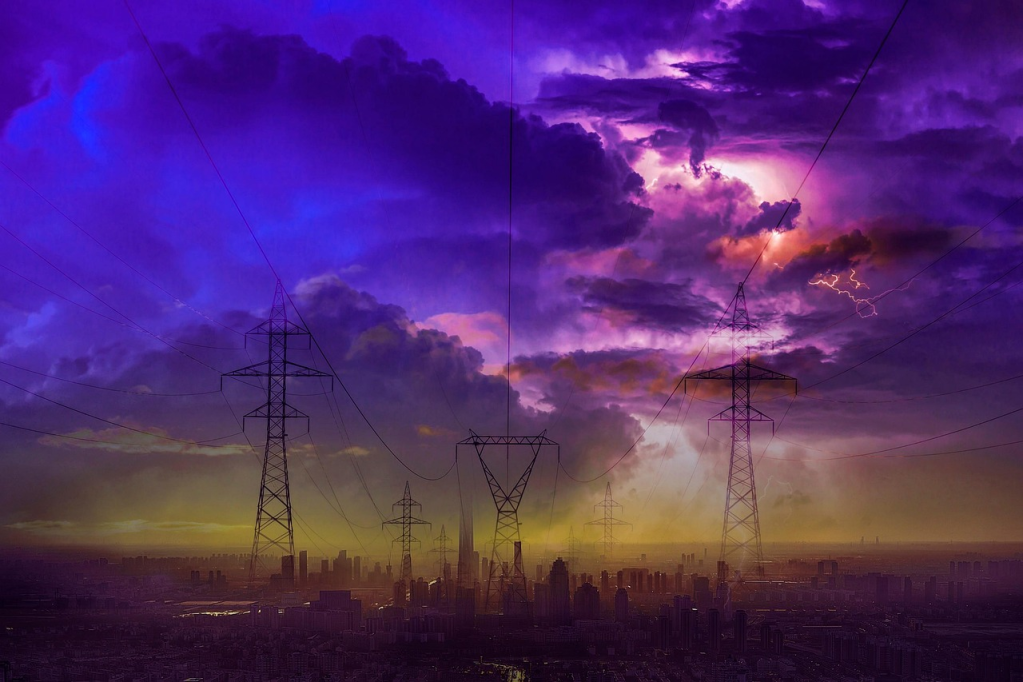
It is Summer 2025 and I am working at my standing desk in a sunny southside apartment in southern Germany. It is one of the hottest days this year. There are many hottest days these days all around Europe. In fact, there are so many hottest days all over the place that many people start worrying about their own resilience to climate change, as well as that of their communities, families, and loved ones. The World Meteorological Organisation even states that every year between 2015 and 2024 had been the hottest year worldwide ever recorded.[i] What do we do if current heat trends continue to rise? What is our personal limit, the number of degrees and humidity that we can tolerate? What do we do if we cannot anymore? Climate change is real, and we are living in the midst of it.

Besides heat waves, there are also many unforeseen and sudden extreme weather events, such as massive rains, storms, landslides and floods. Hurricanes become more frequent and more violent in the Caribbean, as Hurricane Melissa has demonstrated in October 2025.[ii] The growing rhythms of plants are shifting. Many farmers need to water their crops earlier, only to find the harvest threatened by extensive bursts of rain later in summer. Some regions are experiencing crop failures, as insects find new habitats further north and domestic plants struggle to adapt to sinking groundwater levels and sunburn.

Worldwide climate researchers are fearing so-called “tipping points”. If these are reached, they would significantly exacerbate climate change and negative effects on us, animals, and plants. One of the most feared tipping point can be found in the Amazon rain forest in South America. Due to global warming, deforestation, droughts, (humanmade) fires, and human incapability to protect the forest, the world’s largest rain forest could first lose its role as a massive carbon storage (also called carbon sink), and secondly turn into a savannah. If this would happen, it could change “the global water cycle”, “damage[…] biodiversity, affect[…] agriculture, [and] caus[e] food shortages”.[iii]

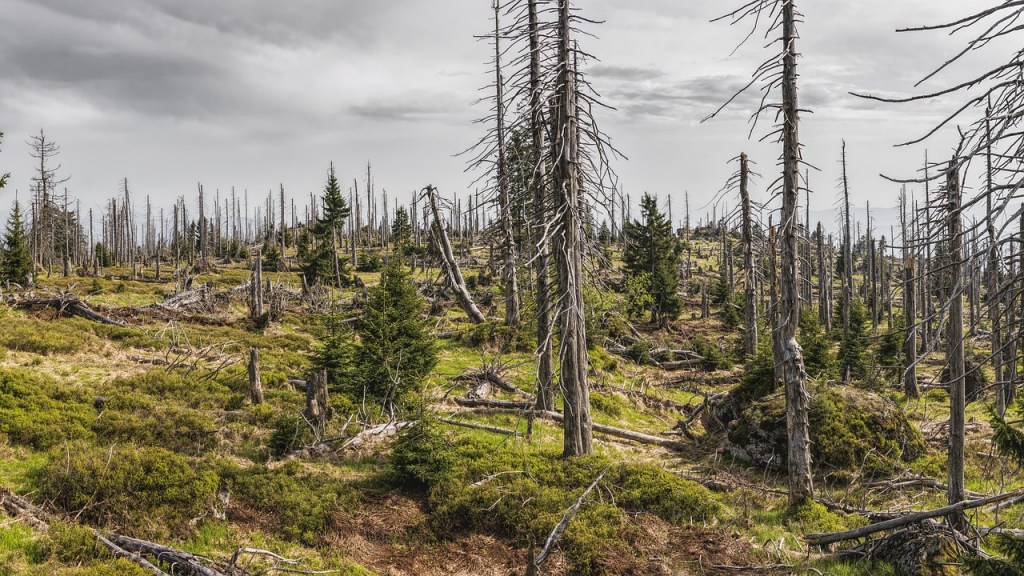
A couple of years ago, the media and politicians told us that Germany’s and the EU’s cornerstone for climate change mitigation were the planting of trees, the protection of forests and the push for expanding the areas on which forests could expand into.[iv] Today a couple of years later, many forests look worse than before.[v] Unable to adapt to climatic changes, many trees fall ill and ultimately victim to bugs, such as the bark beetle. If one drives through the rural area of the Sauerland, in the industrialised Ruhr Area’s hinterland of Western Germany, you might be shocked at the expanse of forest destruction. The old practice of monocultures, in this case of planting spruces, is now causing widespread forest decline.

“Bayerischer Wald” by Felix Mittermeier.

In the meantime, the open-pit coal mines in the Rhineland and Lusatia are expanding, forests are being destroyed for industrial purposes and high-speed roads.[vi] Additionally, the world community seems unable to even agree to basic rules regarding the production of new plastics, the recycling of existing ones, and the safeguarding of the environment from it – one of the contributing factors to climate change via its links to the oil industry.[vii] Disillusionment creeps into every nook of any reflected person’s conscience, if she tries to understand where we are heading, what could have been done to stop it, and the options we are left with.

No, despite the genuine and tremendous efforts of so many individuals, political groups, NGOs, churches and many other people to stop climate change during the last decade(s), to keep the 1.5 °C -cap of the Paris Climate Agreement, and to protect the foundations of a healthy life for all of us, the political landscape, especially the geopolitical, has not prioritised the protection of the environment.[viii] Quite the opposite: Profits, powerplay, expansionism, (neo-)imperialism, war, and capitalist greed are at the forefront wherever one tries to understand, why the world does too little, to avoid environmental and with that our own collapse.

It is a simple, although hurtful, truth that some people have more leverage on political decision-making than others. Liberal democracies may push for individual forms of freedom, but they are evidently unable to bridge the gap between the rich and the poor, between the powerful and the disenfranchised, between the influential and the voiceless. While we all have to always ask ourselves first, what we can do better and what we are complicit in destroying the foundations of our lives, the super-rich, the global companies, and the illicit networks of nepotism and theft are majorly to blame for the situation we are in. Despite the ruling individualist ideology that keeps telling us that our choices count – and of course they do, just not to the level of the more equal circles – it is the choices of CEOs, the Donald Trumps and Elon Musks, as well as the offspring of hereditary circles of wealth and power that are to blame for a large portion of the mess we are in.

Linked to this is also a tremendous backlash that we can witness in many cultural areas, and across the media landscape. Common places like the benefits of a plant-based diet, the equal role of women in the workplace, a rule-based society and international relations, as well as the bottom line of at least trying to be a kind person are under attack now. The headlines are being made by pompous, arrogant, and autocratic, if not outright dictatorial, men that simply gained power through wealth, a disillusionment of the electorate with democratic parties, and the old mixture of hate, fearmongering and proposing simple solutions on the backs of the so-called “others”.

Maybe we got into this situation, because for more and more people life is getting more difficult, while at the same time it seems less likely that traditional democratic parties offer solutions and pathways for a better future. Traditional party coalitions and policy decisions cannot gain the trust of the majority of the electorate anymore. At the same time, extreme right-wing parties as well as all-out Fascist leaders flood social and increasingly traditional media with their easy but hateful propaganda, further exacerbating the crisis of democratic parties and the political system as a whole.

For an activist, it hurts to perceive the right-wing backlash in so many fields of struggle, in which during the last years so much energy has been invested. The pandemic, the Russo-Ukrainian War, the wars in Sudan, the Middle East, Afghanistan and the migration crisis in Europe have all contributed to internal strife in European countries. It is a sign of the weakness of left-wing organisations, let alone parties, that workers and ordinary people see more and more their hopes fulfilled in the rise of extreme right-wing parties. These right-wing organisations are seemingly winning elections all across Europe. When they do, they always undermine democratic institutions and try to establish their own dictatorship, emboldened by neo-Fascist ideology.

It is interesting that from a Marxist perspective, fascism is the next evolutionary step of the neoliberal capitalist order of society. Since the discrepancies between promises and reality, between capitalist greed and the more and more felt planetary boundaries become oppressing, a significant score of people try to smooth over the divisions with autocratic rigidity and the channelling of anger on minority groups. While the Marxists were wrong during the Cold War, it seems now that their analysis proves right again: in order to protect the profits of the chosen few, society has to be autocratically ruled, co-influence by ordinary people abolished, and drastic changes to the group of people introduced that count as “we” or “inside”, in opposition to “them” and the “outside”. All the while, most people are economically struggling. Thus, many fall into the trap of right-wing propaganda. There are many reasons for this. Here, we want to look into energy, its provision and scarcity being one of them.

Most of our political life is determined by energy provision, consumption and safeguarding via an all-encompassing network of energy infrastructures. While getting to the bottom of a political problem, one often finds energy to be involved with it. If we understand energy in the furthest of meanings, we can imagine the main categories of heating, electricity generation, food, health and storage systems. We should look at our world through the eyes of energy experts, system builders, technocrats, and most importantly: ordinary people. Then we can account for what the situation is today in key areas, how we got there and what needs to change in order to mitigate the negative consequences of climate change, the collapse of biodiversity, and the foundations of our societies. Often one argues that humanity cannot change the course of its economic and societal path. I think we can, if we attempt to shift our focus on energy. While all of this is worthwhile the effort, in my eyes it would be unjustified, if we would not together start thinking about how we can actually change the status quo, overcome our differences, and create a just and prosperous world for all.

A better world is possible. Let’s start creating!


[i] World Meteorological Organization: State of the Global Climate 2024 (WMO-No. 1368), Geneva 2025, 3: “For global mean temperature, each of the past ten years, 2015–2024, were individually the ten warmest years on record.” [Deutsche Zahlen einfügen!]

[ii] McCluskey, Mitchell: Hurricane Melissa Leaves a Trail of Devastation after Tearing through the Caribbean, in: CNN World, 31 October 2025, https://edition.cnn.com/2025/10/29/americas/hurricane-melissa-damage-jamaica-cuba-latam-intl [2025-11-01].

[iii] N.N.: The JRC Explains: Could the Amazon Rainforest Become a Savannah?, in: The Joint Research Centre: EU Science Hub, 18 July 2025, https://joint-research-centre.ec.europa.eu/jrc-explains/could-amazon-rainforest-become-savannah_en [2025-11-01].

[iv] See European Commission: New EU Forest Strategy for 2030, https://environment.ec.europa.eu/strategy/forest-strategy_en [2025-08-23]; See World Economic Forum: This Dutch Scheme Is Using Free Trees to Tackle Climate Change, 6 December 2021, https://www.weforum.org/stories/2021/12/tree-climate-change-replanting-forest/ [2025-08-23]; NDR Panorama: PR-Mogelpackung: Bäume pflanzen fürs Klima, 11 November 2021, https://www.ndr.de/fernsehen/sendungen/panorama/archiv/2021/PR-Mogelpackung-Baeume-pflanzen-fuers-Klima,baeume292.html [2025-08-23].

[v] WDR: Viele Wälder im Sauerland und Siegerland zerstört, 07 May 2025, https://www1.wdr.de/nachrichten/westfalen-lippe/waelder-suedwestfalen-zerstoert-100.html [2025-08-23]. Also: N.N.: Weltweit mehr als 8,3 Millionen Hektar Wald zerstört, in: Tagesschau, 14 October 2025, https://www.tagesschau.de/wissen/wald-zerstoerung-zunahme-100.html [2025-10-29].

[vi] For Lützerath: Klüppelberg, Achim: Germany, January 2023: Digging Coal for Profits. Powerlessness and Empowerment in the Struggle for Lützerath, in: Occupy Climate Change, Atlas of the other worlds, Stockholm a. Barcelona September 2023: https://occupyclimatechange.net/lutzerath/ [2025-11-01]. For the protests surrounding the construction of the Autobahn 49 through the Dannenröder Forest: N.N.: Fünf Jahre “Danni bleibt” und die A49. Was vom Protest im Dannenröder Forst geblieben ist, in: Hessenschau, 01 October 2025, https://www.hessenschau.de/gesellschaft/danni-bleibt-und-die-a49-was-vom-protest-im-dannenroeder-forst-geblieben-ist-v2,dannenroeder-wald-108.html [2025-11-01].

[vii] McVeigh, Karen a. Bryce, Emma: Plastic Pollution Talks Fail as Negotiators in Geneva Reject Draft Treaties, in: The Guardian online, 15 August 2025, https://www.theguardian.com/environment/2025/aug/15/plastic-pollution-talks-geneva-treaty [2025-08-23].

[viii] Watts, Jonathan a. Xipai, Wajã: World Faces ‘devastating consequences’ after Missing 1.5 Degrees Climate Target, Says UN Head, in: The Irish Times, 28 October 2025, https://www.irishtimes.com/environment/climate-crisis/2025/10/28/change-course-now-humanity-has-missed-15-degrees-climate-target-says-un-head/ [2025-10-29].

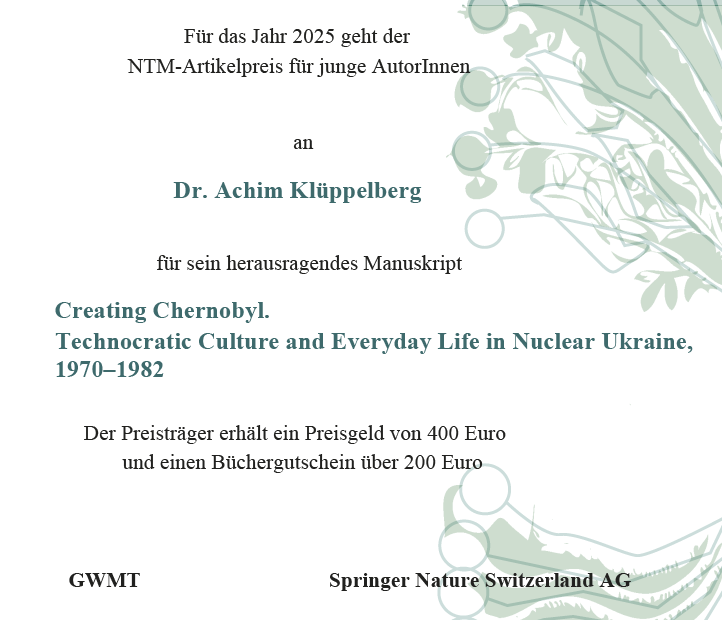
NTM Article Prize 2025 Ceremony in Dresden

On 25 September, I was invited for this year’s GWMT annual meeting to Dresden, Germany. Within the halls of the German Hygiene Museum in Saxonia’s capitals I received the NTM Article Prize for Young Authors. My article “Creating Chernobyl. Technocratic Culture and Everyday Life in Nuclear Ukraine, 1970-1982” convinced the board. Naturally, I am very grateful and happy for this award.

Nadine Metzger and Christopher Neumaier hand over the price to the author. Picture by the conference organisers.

Furthermore, I was honoured by the outstandingly kind laudation, held by Prof. Dr. Christopher Neumaier. Many thanks go to the organising committee and everyone who contributed to thie marvellous evening. Of course, I am also very grateful for my former working environment at KTH Royal Institute of Technology, where I was educated and enabled to conduct that sort of research, which was now rewarded. After all that struggle introducing the new analytical concept of Technocratic Culture to energy historiography, it felt amazing to find recognition along the peers of the GWMT.

Here is the article, which found such splendid reception:

Creating Chernobyl. Technocratic Culture and Everyday Life in Nuclear Ukraine, 1970–1982/ Der Bau des Atomkraftwerks Tschernobyl. Technokratische Kultur und Alltag in der ukrainischen Atomwirtschaft, 1970–1982

Abstract:

Starting in 1970, this article studies how Chernobyl Nuclear Power Plant was built. It follows the station’s operational history until 1982. During that year, reactor block one suffered a torn reactor channel, four years prior to the well-known catastrophe of 1986. It uncovers the genesis of these accidents by analyzing everyday history at the construction site. Construction relied on long established tools and processes, tried out at large-scale and mostly non-nuclear development areas. Masons, carpenters, and welders dealt with planned quotas and deadlines, material and personnel shortages, as well as a lack of quality management. The tools they used to build this nuclear giant were rather a shock of the old (Edgerton) than futuristic.

It uncovers circumstances, non-alignments, and decisions that amounted to a working environment characterized by a technocratic culture. This culture overemphasized the fulfillment of plans and quotas to the detriment of safety as should have been warranted by the nature of a nuclear reactor as specified in plans and regulations. By following the plant’s construction in its everyday struggles, this article shows characteristics of the working culture that evolved on-site and led to the accident of 1982. This innovative approach aids understanding of why and how the catastrophe of 1986 came about—beyond the two standard reasons established in the literature, namely a faulty reactor design and mistakes made by the operators.

Zusammenfassung:

Dieser Artikel untersucht die Entstehungsgeschichte des AKWs Tschernobyl durch die Analyse des Alltags auf der Baustelle von 1970 bis 1982. In diesem Jahr platzte ein technologischer Kanal in Reaktor 1, bereits vier Jahre vor der bekannteren Katastrophe in Reaktor 4. Der Baustellenalltag basierte auf tradierten Vorgängen und Geräten, die bereits zuvor auf großangelegten und größtenteils nichtnuklearen Anlagen zur Anwendung kamen. Maurer, Schreiner und Schweißer mussten Quoten und Fristen einhalten, mit nicht ausreichendem Material und Unterbesetzung zurechtkommen und Wege finden, mit schlechtem Qualitätsmanagement umzugehen. Die Mittel, die sie dafür nutzten, waren dabei eher herkömmlicher als futuristischer Natur (nach Edgerton’s shock of the old).

Hier werden Umstände, Unzulänglichkeiten und Entscheidungen analysiert, die grundlegend für ein technokratisches Arbeitsumfeld waren. Diese technokratische Kultur betonte die Planerfüllung, während sie der Sicherheit nicht die Wertschätzung beimaß, die durch die Natur eines Kernreaktors, wie in Regularien spezifiziert, hätte vorgegeben sein sollen. Dabei werden durch die Analyse von Alltagsproblemen die Charakteristika einer Arbeitskultur aufgezeigt, die sich vor Ort entwickelte und zum Unfall von 1982 führte. Dieser neue Ansatz hilft zu verstehen, warum und wie die Katastrophe von 1986 begann. Dabei geht er weiter als die beiden bisher in der Literatur etablierten Gründe des mangelhaften Reaktordesigns und der Bedienungsfehler durch die Operatoren.

The Hidden History of Soviet Nuclear Plans at Lake Võrtsjärv in Estonia

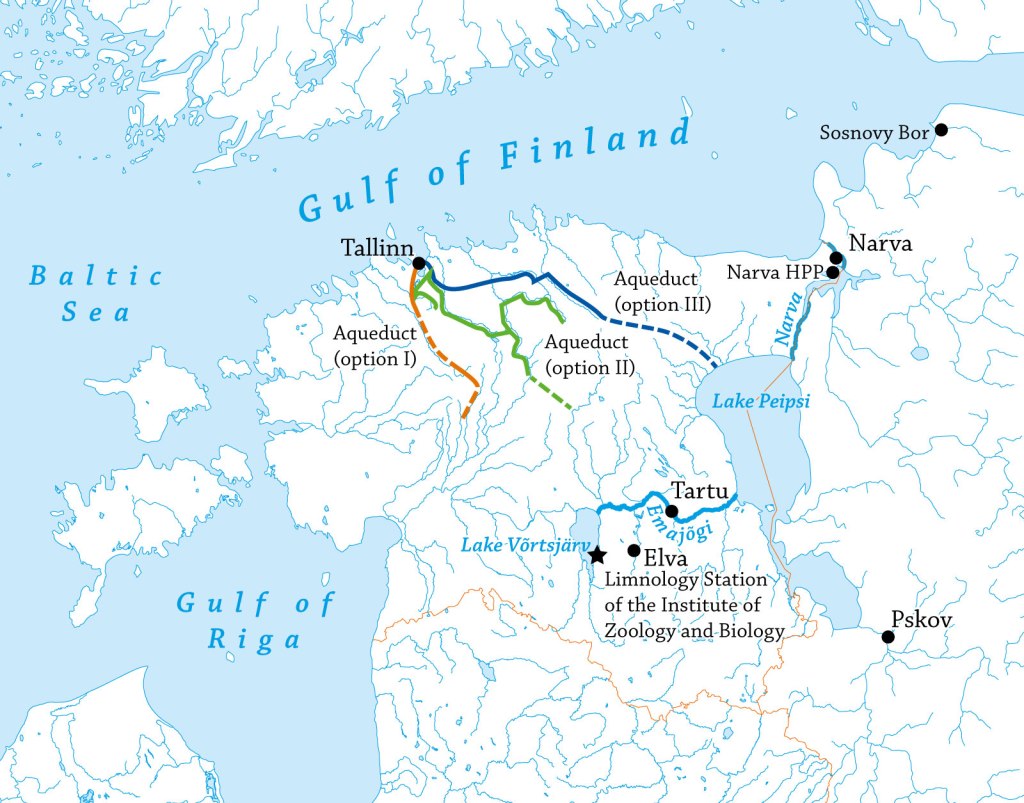
Recently, Kati Lindström‘s and my article about a Soviet-Estonian nuclear power plant never actually built at Lake Võrtsjärv has been published in the journal “Environment and History“. Honestly, this is awesome! Kati and me worked so hard on this article since 2019, when I first came across an ominous nuclear power plant dot in a map of Charles Dodd’s book “Industrial Decision-Making and High-Risk Technology”. I was struck, because this dot was located in Estonia. But up to my knowledge, there was never a large-scale nuclear power plant realised in this Baltic country. So in our Stockholm office I went up to Kati and asked her about it. Intrigued, she tapped into her Estonian network and it turned out that there was actually much more to it than we initially thought… and off we went to Estonia to hunt the ghost of this nuclear power station. In the end, this ominous dot could have simply been a mistake on that map. Nevertheless, it led us to an adventurous path of research, in which we discovered an exciting history of relatively concrete plans to build said nuclear station. Ultimately, this story was more about fish and the actual waterbody that was supposed to feed four RBMK-1000s (Chernobyl-type reactors), than nuclear technology or uranium.

Võrtsjärv in the Estonian aquatic system and the ESSR Amelioration Committee’s 1974 plans for Tallinn’s water provision (continuous lines indicate existing sections, dotted lines development options). Own map, Redrawn from ERA.R-2290.1.512.

In any case, a huge shoutout to Kati Lindström, with whom it was an absolute pleasure to discover Estonian nuclear history. I also want to mention all of our awesome interviewees, who shared their stories with us and who gave us a plethora of oral sources in a situation characterised by the total abscence of any accessible written documents regarding this case. Sadly, some of these people are no longer with us and cannot read what we produced based on their testimonies. Additionally, I also want to thank all archivists that helped us in Estonia, Lithuania, Russia, and Ukraine to find this one golden file. Sometimes, good articles need six years until publication!

So, if you are interested in this open-access publication, you can find it here! Enjoy!

Abstract

One of the most mysterious stories in Estonian energy history revolves around the planning of a nuclear power plant (NPP) at Lake Võrtsjärv between 1967–1972. Despite the absence of planning documents in the energy archives and the impracticality of an NPP given Estonia’s abundant oil-shale energy production, the story, though sounding fishy, is well established in media and oral sources.

In a regime where open confrontation with the central government was risky, alternative resources in the envirotechnical system of the NPP, such as water, fish and land, were mobilised to protect the lake. By utilising envirotechnical systems as a method to locate alternative sources, we have traced the negotiations within the central planning processes of inland fisheries and water resources. As ecosystemic nature protection strengthened, scientists managed to defer the NPP and reorganise the entire fisheries industry at Lake Võrtsjärv, recovering the populations of valuable fish.

Citation

Lindström, Kati, and Klüppelberg, Achim. “A Fishy Tale of the Nuclear Power Plant Never Built in Estonia: An Envirotechnical History of Energy, Fish, Land and Water Resources Planning at Lake Võrtsjärv.Environment and History, 04 August 2025.

ESEH 2025 Is Coming Up Soon!

From 18 until 22 August this year many environmental historians, historians of technology, artists and discussion-enthusiasts are going to meet up in Uppsala, Sweden. The European Society for Environmental History invites us to participate in this lovely city about an hour north of Stockholm. The biannual ESEH conferences are always a highlight in any historian’s calendar. Therefore, it pains me a little that this year I cannot attend, due to the obligations of my current job. Nevertheless, in the following I do take the liberty to add my 50 cents on this year’s programme (especially from a nuclear and energy perspective), to highlight my personal must-go-to events, and to wish you all attending tons of fun!

Programme (abbreviated version)

Programme highlights

On Monday, 18 August 3-6pm, the NEXTGATe Worksop “Letdowns, Underachievements, Shortcomings? Reimagining Failure for a Healthier Academic Ecology” takes place under the chairing eyes of Monica Vasile and Roger Norum. Here, especially early career scholars can exchange ideas on how the normalisation of failure takes of the edge of something so fundamental to the research process.

Starting on Tuesday, 19 August 11am-12.30pm, the first of multiple sessions on “Energy Transitions and Energyscapes” takes place. Our former Nuclearwaters-colleague Melina Antonia Buns will chair this event. In general, energy discussions are all over the trope of transitions, whether imagined or not, and this format will certainly help to navigate novel ideas on it. The second leg will take place in the afternoon, 2-3.30pm.

Elena Kochetkova and Doubravka Olsakova invite us to a discussion on “Zero Growth and Climate Change in Eastern Europe Before and After 1989” in the same afternoon, 4-5.30pm.

On Wednesday, 2-3.30pm, Benjamin Bererle and Reinhild Kreis chair a session on the – unfortunately – everlasting question of “How to Organize Scientific Conferences (like ESEH) without Exacerbating the Climate Crisis?”, befittingly in an hybrid format allowing for digital and in-person attendance.

Shortly afterwards, from 4-5.30pm, the panel “Nuclearises Waterbodies. Following Protagonists Building Nuclear Landscapes” will bring together diverse scholars that work on the linkage of nuclear and water, chaired by Siegfried Evens. I would have been part of this panel and I can only advertise to go there and to join the discussion!

So, whether you are participating at ESEH in person or digital, I wish you a marvelous time in (digital) Sweden, with hopefully still great weather and outstanding scientific discussions!

Further reading

Klüppelberg, Achim: Creating Chernobyl. Technocratic Culture and Everyday Life in Nuclear Ukraine, 1970-1982, in: NTM Zeitschrift für Geschichte der Wissenschaften, Technik und Medizin, Published online 31 July 2025.

Lindström, Kati a. Klüppelberg, Achim: A Fishy Tale of the Nuclear Power Plant Never Built in Estonia: An Envirotechnical History of Energy, Fish, Land and Water Resources Planning at Lake Võrtsjärv, in Environment and History, Published online, 04 August 2025.

The Technocratic Culture Behind Chernobyl’s Disaster

Recently my new article about nuclear Ukraine was published in NTM Zeitschrift für Geschichte der Wissenschaften, Technik und Medizin. As you might know, my dissertation analysed the nuclear power industry in the Soviet Union from a technocratic culture point of view. In this article, I am using this perspective to analyse what was going on at Chernobyl Nuclear Power Plant before that fateful night in April 1986, when reactor block four exploded.

This AI-generated picture portrays a purely fictional idea of a large-scale construction site in neonpunk style.

The purpose of the image is to evoke emotions about a futuristic and presumably progressive construction site, as it was perceived in 1980.
Created with Automattic AI. This picture is purely fictional.

Title:

Creating Chernobyl. Technocratic Culture and Everyday Life in Nuclear Ukraine, 1970-1982

Abstract:

Starting in 1970, this article studies how Chernobyl Nuclear Power Plant was built. It follows the station’s operational history until 1982. During that year, reactor block one suffered a torn reactor channel, four years prior to the well-known catastrophe of 1986. It uncovers the genesis of these accidents by analyzing everyday history at the construction site. Construction relied on long established tools and processes, tried out at large-scale and mostly non-nuclear development areas. Masons, carpenters, and welders dealt with planned quotas and deadlines, material and personnel shortages, as well as a lack of quality management. The tools they used to build this nuclear giant were rather a shock of the old (Edgerton) than futuristic.

It uncovers circumstances, non-alignments, and decisions that amounted to a working environment characterized by a technocratic culture. This culture overemphasized the fulfillment of plans and quotas to the detriment of safety as should have been warranted by the nature of a nuclear reactor as specified in plans and regulations. By following the plant’ s construction in its everyday struggles, this article shows characteristics of the working culture that evolved on-site and led to the accident of 1982. This innovative approach aids understanding of why and how the catastrophe of 1986 came about—beyond the two standard reasons established in the literature, namely a faulty reactor design and mistakes made by the operators.

Full citation:

Klüppelberg, Achim: Creating Chernobyl. Technocratic Culture and Everyday Life in Nuclear Ukraine, 1970-1982, in: NTM Zeitschrift für Geschichte der Wissenschaften, Technik und Medizin, Published online 31 July 2025.

Freely available version (read-only)

New Publication: Exploring Chernobyl’s Connection to Dnieper Hydropower

Today my article “Joining the Dnieper Cascade. An Envirotechnical Water-History of Chernobyl Nuclear Power Plant, 1927-1986” was published online in the journal Water History. I am really happy that this was possible. You should check it out! Unsurprisingly, I am indebted to so many people who supported me during the four years this little project took. Thank you all!

Abstract:

Chernobyl Nuclear Power Plant was built at the northern tip of the Dnieper Cascade, a vast industrialisation effort comprising six hydropower plants and their reservoirs. In hydropower’s eyes, the nuclear station can be seen as the seventh extension to the cascade. While Chernobyl took nuclear power to Ukraine from 1970 onwards, its construction was based on experiences gained during the development of these six conventional stations, starting in 1927. Concrete and water, mundane building technologies, mass mobilisation and the attributes of the planned economy characterised the early years of this nuclear giant, not the hunt for uranium or reactor technology. On many levels of institutional and personal hierarchy, overlaps existed between hydropower and the nuclear industry, as water expertise was crucial for Ukraine’s nascent nuclear sector. If Chernobyl is being interpreted as part of the Dnieper Cascade, it becomes clear that the station took a new dimension to the previously established envirotechnical system created by the construction of the cascade. Radioisotopes stemming from its four reactors contaminated the Dnieper catchment area, linking the station via the cooling pond and the Pripyat River, over the Dnieper with those six massive reservoirs, to the Black Sea and thus to world oceans. By contaminating waterways and wetlands, which led to a permanent recirculation of radioisotopes along human, animal, and plant food chains, Ukraine’s first nuclear power plant irrevocably renegotiated the envirotechnical system along the country’s largest river.

Keywords: Chernobyl, envirotechnical system, Dnieper Cascade, nuclear energy, Pripyat, Dnieper

How to get the article:
Klüppelberg, Achim: Joining the Dnieper Cascade. An Envirotechnical Water-History of Chernobyl Nuclear Power Plant, 1927-1986, in: Water History, Received 14 August 2024, Accepted 08 May 2025, Published online 09 June 2025.

You can also drop me a message under achim.klueppelberg[at]t-online.de, if your institution does not have a subscription to Water History.

“Mutig, Stark, Beherzt” in Hanover. The 39th Kirchentag and My Impressions of a Crazy Week

What type of society do we want to live in? What role will religion play in it? How can I as an individual relate to current challenges of society? These and so many more questions were asked and at least partially answered at this vast event in Lower Saxony around the first of May.

About 100,000 visitors came to the event, enjoying over 1,500 single venues created by over 30,000 active contributors. Kirchentag is a biannual event that came into being after World War Two was finally over and the Protestant Church(es) had to come to terms with their Nazi-past. From its inception, the Kirchentag was always a movement of lay people contrasting the official church. Critique, ambition, enthusiasm, and the need for changes drove this mega event from the beginning. This year was no different.

From 28 April until 5 May 2025, I was working in Hanover. During that time, I fulfilled a role as event manager in the programme division of the Kirchentag. It was my responsibility to make sure the 83-ish individual events of the Centre for Children and Families could run smoothly, safely and to the joy of all participants. These events were scattered around five different locations in Hanover’s city centre: the House of Youth (“Haus der Jugend”), the Neustädter Church St. Johannis, the Kreuzkirche, the Opera Place and the “Masch-Park”.

“Abendsegen Kerzenmeer” by Kirchentag/ Weise.

During the preparation for this mega-event, I was fortunate to get to know a team of brilliant co-workers. From the very beginning, they put me under their wings and helped me to quickly pick up where my predecessors had left things. Thanks to them I was able to relatively quickly gain an overview and find myself being productive in preparing the centre’s events.

This spirit continued as the actual proceedings took place. Most of the time I had my working space in our office at the northern district of the fair in Hanover. From there I helped to coordinate last minute tasks and to put out some minor organisational fires that came up. Besides, I visited the actual event locations on-site, focussing on the Kreuzkirche and the House of Youth. As support I had the wonderful help of a volunteer, who acted as my double and with whom I worked in close collaboration throughout this phase. (If you are reading this: Thanks a lot!)

My time on-site was the most intense. In general, our events were largely a success. Many people came and especially the House of Youth attracted between eight and ten thousand visitors a day. Especially on Thursday evening, after the first full day, I was very happy. It seemed like all the work would pay off: many people came, nearly everyone was happy and most events were packed with participants. One of the reasons why this went so smoothly was the excellent coordinating work of our rangers on-site. A big “Thank you!” for your great help as well!

“Ehrenamt” by Kirchentag/ Harbart.

On Friday and Saturday this trend continued. But during these days we had some problems with three neuralgic events – events that provoked critique in the public. In general we handled the occuring situations quite well, although I am personally not happy with some outcomes. Especially on Saturday the right-wing reports about our events caused a climate of fear amongst some of our participants. Even though no confrontation occured, some people rather stayed away from the House of Youth and you could feel that in the end.

The fear some biased right-wing media outlets produced, was disgusting and had nothing to do with journalism or a based discussion about the contents of some events. Furthermore, two of our contributors were named in those outlets, which resulted in one case in complications at the workplace, since angry calls registered there. As the situation was more or less over for me by Sunday, it continues to stay problematic for these two contributors also on levels far beyond the Kirchentag. Something which is not fair at all and which keeps me thinking to this day.

The thing is that it is perfectly fine to criticize some events on a content-level. I myself take issue with some of them. Especially in terms of theology as I understand it, one could argue that our programme had in many parts left biblical foundation and justification. After all, the Kirchentag could have been a forum to discuss all this in a peaceful and friendly manner. However, one take-home-message for me is that some so-called journalists from right wing media lie to you about who they are and that they are not interested in a debate resulting in dialectic progress. Instead, all they care about is the clash and the attention-harbouring created in social media to fund with the resulting revenues their agendas. It was never about critique and debate, it was about a clash of cultures and the attempt to discredit the perceived enemy. What a pity and what a waste of possibilities.

The end of the Kirchentag marked the final service, in which Hanna Reichel gave a pretty interesting sermon along the powerful lines of us having a choice: we shall either learn to live together and share the land we inhabit, or we will have to share the cemetary beneath it. A statement that should keep us thinking about how we handle opposing opinions.

“Schlussgottesdienst Performance Weltkugel” by Kirchentag/ Johna.

For me this had been an exciting adventure, during which I was very lucky to be able to learn a ton about event management on this scale. I got to know so many lovely people and am extremely grateful for the opportunity to contribute to its success. It will still need some time for me to think everything through that happened and to figure out what I should take with me for the next event. But in any case, it was very exciting!

Writing of which: by now I am working fulltime for the upcoming 104. Catholic’s Day in Würzburg, which will take place in May next year. Save the date, if you are interested. Although smaller than the Kirchentag, it will feature exciting events as well and tons of opportunities to pick up the dialogue.

The 39th Anniversary of the Chernobyl Catastrophe in a World Blind to Environmental Concerns

Unfortunately, I am getting a bit angry at society at large during these last months. Sure, there were many larger and smaller political issues that demanded time and attention from everyone. Lest we forget that there is a brutal war going on in Ukraine, Palestine, Yemen, and unfortunately many other parts of this world. But have most people seriously gone nuts over tariffs on Bourbon, peanut butter, Harley-Davidsons, cars, iPhones, and what not? Don’t get me wrong – what Trump is doing to the US looks to me from the outside like Fascism in spé, and the other dictators in the world never disappoint if we need more uplifting topics to talk about over lunch.

But have you – like most of the mainstream media in the so-called Western World – forgotten the ongoing climate crisis amidst the relentless claims that refugees and migrants would ostensibly be the rootcourse of all the problems caused by capitalism? On 15 April the World Meteorological Organization proclaimed that 2024 was the warmest year in Europe ever recorded:

“Europe is the fastest-warming continent, and the impacts of climate change here are clear. 2024 was the warmest year on record for Europe, with record temperatures in central, eastern and southeastern regions. Storms were often severe and flooding widespread, claiming at least 335 lives and affecting an estimated 413,000 people. During the year, there was a striking east-west contrast in climate conditions, with extremely dry and often record-warm conditions in the east, and warm but wet conditions in the west.” (World Meteorological Organization, 15 April 2025).

Oh, and three days later a “Deadly storm” (Deutsche Welle, 18 April 2025) hit Italy, Switzerland and France, causing floods, destruction, electricity outages, and suffering. But sure, to quote the media’s new favourite US-American President, “They never talk about the environment anymore. You know why? […] It’s one of the great scams of all time.” (Friends of the Earth, 12 July 2018). I wonder what the people of New Orleans think about such statements. But – unfortunately – Trump is right in one thing: the climate movement has become quieter, as resources dwindle, activists are under repression and stress (think about the lawsuit against Greenpeace in the US), and the overall bombardment of the media fills everyone with dreadful images of war and immediate threat by our neighbours. Out of the playbook of Gustave Le Bon’s “Psychology of the Masses“.

Well, the legacy of Chernobyl refocusses our attention back to the state of the environment and what we as humans are doing to everything living on this earth. With ever greater ingenuity we are inventing new ways to kill each other, to control the movement of people, to collect humanity’s data, to make rich people richer and the poor even poorer. All with great success. And yet, we fail miserably in containing the problems caused by ONE wicked nuclear reactor out of the roughly 450 active ones in the world that exploded. By the way, if someone has still not gotten the memo: nuclear energy does not help in trying to mitigate the consequences of human-made climate change. While it takes too long to build and is too expensive, it simply poisons us and the plants and animals we are living from.

As news like the drone strike on the Chernobyl sarcophagus on 14 February 2025, which caused a hole in precisely that shelter that is supposed to protect Europe from the still radiating remains of Chernobyl-4, came in, it seems most people were simply more concerned, whether the prices for a new iPhone (who needs a new iPhone anyway?) will go up because of Trump’s erratic trade policies. In the meantime – and people who read my texts know that I have a critical attitude towards the nuclear industry – heroic workers at Chernobyl Nuclear Power Plant are trying to repair the damage done by the horrible war taking place. Surely, a Bundeswehr bolstered with billions and billions of euros to ostensibly protect Germany against foreign threats has come to the aid of wartorn Ukraine in repairing the structure, wouldn’t they? I was waiting for a news story announcing that. Maybe it has slipped my attention, but I guess they have rather spent the money on US-American weaponry.

So, while the great mass extinction is going on all around us for everyone with eyes to see, most people I know are rather busy with following the next nuisance the powerful people of this world are coming up with to keep everyone busy and to keep the dollar, the euro, the rouble, the yuan, the yen, and whatnot rolling into the right pockets. Sorry, I am frustrated and I hope, that in this regard, you are, too.

If anything, Trump and Co did succeed in flooding the media with their agenda, keeping everyone busy like headless chicken. In the meantime, we are destroying the foundation of the world sustaining our lives. Please, stop worrying so much about iPhones, Teslas, the biographies of mega-capitalists, and other useless stuff. Instead try to help your local community, your local forest, and the few wild animals left around us. Shop sustainably – or better do not shop at all. Since we are talking about Chernobyl here, go ahead and get your electricity from truly sustainable sources and support companies that work to get rid of the nuclear in the mix. Maybe go and get your own solar panel this summer. Make a choice!

The legacy of Chernobyl demands that from us.

The World Looks at Different Things – But We Are Still Not Forgetting Fukushima-Daiichi

Old governments go, new ones come; right-wing politicians draw one media stunt after another; Donald Trump, Elon Musk, and JD Vance take it upon themselves to reintroduce unveiled predatory capitalism (not like the US didn’t show that sort of behaviour before), destroying democracy and turning the United States more than ever into a blatant oligarchy; the Ukrainian president Volodymyr Zelenskyi was made to look silly by former allies and fried alive by supposedly allied media; and the climate crisis is taking its toll worldwide as we have now officially breached the 1.5 C° global warming threshold in comparison to the pre-industrial average. Hej – who believed in the Paris Climate Agreement anyway these days, if you can order shiny Cybertrucks from Musk’s Tesla factories?

Fukushima-Daiichi Nuclear Power Plant before the disaster (nuclearwaters.eu).

But even though we are rightfully focussed on these things – which will inevitably profoundly change the world we live in – as an historian I need to contribute to keeping the memory of one of the largest nuclear disasters in the so-called civil nuclear industry alive: the disaster of Fukushima-Daiichi Nuclear Power Plant on 11 March 2011, following the huge Tōhoku earthquake and the following Tsunami.

3/11 is still an ongoing catastrophe, as the molten reactor cores are still not salvaged and the necessary cooling of the toxic material continuously generates scores of irradiated water, which in turn gets diluted and released into the Pacific Ocean. This now established practice by the Tokyo Electric Power Company caused criticism in the international community. China and South Korea, for example, have heavily protested against it. The fear of contaminated fishstocks and other marine animals and plants provoke scepticism in consumers and producers.

Furthermore, the decontamination efforts in the areas surrounding the failed nuclear power plant are stagnating. Once again, the argument pivots around the question whether constant levels of low-level radiation are harmful or not. While there is no absolute conclusive scientific evidence on this question, I personally find it likely that it does. Here, I would like to point out to the excellent book by colleague José Tapia, titled “The Chernobyl Disaster and the Mortality Crisis in Eastern Europe and the Former USSR” (De Gruyter 2022). Tapia managed here, to show how low-level radiation has actually caused tremendous harm in the aftermath of Chernobyl Nuclear Power Plant Disaster in 1986. In any case, and switching back to Fukushima, the question remains on what to do with contaminated earth, villages, trees, fields, and forests. As everywhere in the world, Japan also does not have a viable long-term solution to the radioactive waste caused by Fukushima-Daiichi.

The decommissioning process is extremely difficult and continues only at a haggard pace. So far, there is no realistic date in sight, and the consequences of this failure will continue to influence the regional and global flora, fauna, and human lives. Among loud voices from newly elected right-wing politicians that ostensibly nuclear power could be a motor for renewed economic growth, it is important to remember what kind of havoc this technology can cause. 14 years after the catastrophe, we are still trying to understand its consequences. In the meantime, Japan announced to put again more emphasis on its nuclear reactor fleet for the time to come.

Further Reading:

Tapia, José A.: Chernobyl and The Mortality Crisis in Eastern Europe and The Former USSR, Berlin a. Boston (De Gruyter) 2022.

Nippon.com: 14 Years On: Governor Urges Disposal of Fukushima Soil Outside Prefecture, 10 March 2025.

McCurry, Justin: ‘An Act of Betrayal’. Japan to maximise nuclear power 14 years after Fukushima disaster, in: The Guardian, 12 February 2025.

Khalil, Shaimaa: Japan to Increase Reliance on Nuclear Energy in Post-Fukushima Shift, in: BBC Online, 18 February 2025.

Burnie, Shaun a. Kawase, Mitsuhisa: The Japanese Government’s Decision to Discharge Fukushima Contaminated Water Ignores Human Rights and International Maritime Law, in: Greenpeace International Press Release, 13 April 2021.

Klüppelberg, Achim: The Nuclear Waters of the Soviet Union. Hydro-Engineering and Technocratic Culture in the Nuclear Industry, Dissertation at KTH Royal Institute of Technology, defended on 22 March 2024 in Stockholm, Sweden.

Exploring Event Management: My First Week at the 104th German Catholic’s Day

So much has happened since my last post here. The phase of writing applications had been long and tiresome, but by now I managed to find an exciting and promising new position. Here, I would like to share a bit about that work with you.

The palace in Würzburg, Germany, next to the Main River.

Since 17 February 2025, I am working as event manager in the programme division of the 104th German Catholic’s Day (104. Deutscher Katholikentag) that will take place in Würzburg (Germany) from 13-17 May 2026. Last week was basically my first week. I got to know a team of brilliant and highly motivated colleagues and am hyped to become part of this dynamic team. From what I can see so far, it will be an exciting journey until May next year, during which I am going to learn exceptionally much in a brief amount of time. I am also very curious about the people I will be able to connect to, expanding my network within the sphere of church-related organisations in Germany and beyond.

Making things even more exciting, during my first months I will also be working in the programme division of the Protestant “Kirchentag“, which will take place in Hannover (Germany) from 30 April to 04 May. Last week I was also able to get to know the colleagues there at the headquarters in Fulda – an equally amazing experience as it was the case in Würzburg. It is astounding how much I have seen and learned already in my first week – and I am very grateful to everyone making this possible.

Considering all of this, it is great to see that what I learned in Stockholm I can now use in my new capacity. Especially during the current political situation, I think it is important to have a positive impact on society. Something, I will now be able to contribute to with what I have learned so far. Now onwards to new experiences in 2025!